The Weight of a Hand-Strung Strand
Pick up a genuine strand of navajo pearls. The weight hits you first. Not the visual weight—the physical heft in your palm. A 24-inch strand of 8mm sterling rounds, hand-fabricated by a single silversmith working at a bench, sits around 95 to 110 grams. Each hollow bead starts as a flat disc of Sterling 925 sheet, gets domed, soldered, and burnished. You can feel the hours in it. The cord snakes through a 0.45mm silk thread, or historically, sinew. The bead ends bite slightly at the knot points. It makes a sound when you move—a low, percussive click, not the tinny rattle of electroplated knockoffs.
This guide lays out exactly how I style these pieces, what separates authentic work from tourist-grade reproduction, and how to build a collection that pairs with a linen blazer as naturally as it does with a broken-in denim jacket.
What Actually Defines a Navajo Pearl
Let’s clear the noise. A Navajo pearl is not a pearl. It contains no calcium carbonate. No Pinctada Maxima oyster ever touched it. The term “pearl” refers purely to the silhouette—a sphere, slightly irregular, hand-formed from sterling silver. Early silversmiths in the 1880s learned to dome two half-spheres, solder the seam, and string them into strands that echoed the look of the shell and turquoise heishi necklaces already central to Southwestern adornment.
sterling silver navajo pearl beads distinguish themselves through tool marks. Under a 10x loupe, you catch the fine striations of a burnishing tool, the faint ripple where the two domes met. Machine-made beads, cast in bulk overseas, carry a uniform seam—a hairline equator visible on every bead. Authentic work varies. Bead #47 on the strand might weigh 0.2 grams more than bead #48. That inconsistency is the signature.
Benchmarks for Material Integrity
I inspect new acquisitions against three data points. First, the silver standard: Sterling 925, no exceptions. Second, the cord construction—0.45mm braided silk with hand-tied knots between each bead signals individual stringing. Nylon monofilament with no knots means a machine-strung piece. Third, the clasp. A fabricated hook-and-eye in Sterling 925 with a soldered bail points to independent silversmith work. A lobster clasp in 14K gold-fill over brass tells me the seller cut corners on hardware.
Right now, the market shows a flood of “Navajo-style” strands coming out of Albuquerque trading posts with beads at 6mm, lightweight at 55 grams per 24-inch strand, priced under $80. They serve a purpose for costume layering. Just don’t confuse them with investment-grade work weighing north of 100 grams.
Modernizing Southwestern Silver: The Reset
The old styling playbook leaned heavily into Santa Fe clichés—pair your vintage navajo pearl necklaces with turquoise squash blossoms, concho belts, and broomstick skirts. Gorgeous for ceremonial contexts. Stifling for a Tuesday morning coffee run in SoHo. My entire creative direction at PearlsNation revolves around one rule: treat the silver like a neutral.
I wear a 20-inch strand of 10mm vintage Navajo pearls—circa 1970s, sourced from a private collection in Gallup, 130 grams, heavy patina—with an oversized white cotton poplin button-down, collar open, sleeves rolled twice. The pearls land right at my collarbone. Behind them, a single 1.2mm black leather cord laces through a 22K gold briolette, a piece I picked up from a jeweler in Kyoto. The two necklaces don’t match. They talk to each other. The silver absorbs light; the gold throws it back.
Asymmetry as Intent
Symmetrical placement reads ceremonial. Asymmetrical placement reads intentional. I offset my strands so the clasp sits at my left clavicle, not centered at the nape of my neck. The drop shifts a half-inch to the left. This slight misalignment draws the eye diagonally across the body, breaking the rigid formality that can make silver feel stiff.
Last month, for a gallery opening, I layered three strands: an 18-inch 6mm vintage set, a 22-inch 8mm contemporary strand by a Navajo silversmith working in Flagstaff, and a 28-inch strand of 4mm white keshi pearls—Pinctada Margaritifera tissue-nucleated, baroque shapes, 0.8mm nacre thickness. The keshi broke the density of the silver. The mixed scale created depth. Total weight around 180 grams distributed across my neck and décolletage. Wore it with a charcoal cashmere crewneck, no jewelry on the ears, hair pulled back tight. The silver did the work.
Scale and Silhouette: The 4mm to 12mm Spectrum
Bead diameter dictates silhouette more than any other variable. I work across four categories in my personal collection:
4mm to 6mm beads: These sit close to the neck. Strung at 16 to 18 inches, they function like a choker. I treat this scale as a texture piece—layer two or three strands in mixed patinas against bare skin, or let a single strand disappear under a shirt collar so only the top curve shows. Lightweight at roughly 30 to 45 grams per strand.
7mm to 8mm beads: The utility scale. Strands at 20 to 24 inches weigh 70 to 110 grams. These slip under a blazer lapel without bulging. I recommend this range for anyone choosing navajo pearls for modern collections—they transition from day to evening without looking either too delicate or too imposing.
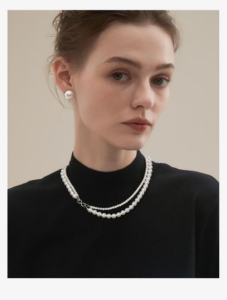
9mm to 10mm beads: The statement scale. A 22-inch strand in 10mm weighs roughly 130 to 150 grams. Worn solo against a stark black turtleneck, this scale reads architectural. You don’t need other necklaces. The beads hold their own negative space.
11mm to 12mm beads: Collector territory. These strands exceed 160 grams. They require a certain physical presence to wear comfortably for extended periods. I own one 12mm strand, 20 inches, sourced from a 1980s estate auction in Scottsdale. I wear it maybe twice a year, always with a simple silk slip dress. The beads demand that level of restraint.
Layering Formulas That Work
I develop lookbook formulas for our site, and these three combinations have the highest return on effort for authentic southwestern silver jewelry styling:
The Architect: One 22-inch 8mm Navajo pearl strand (Sterling 925, 105 grams, hand-knotted on 0.45mm silk). One 30-inch 2mm box chain in 14K gold, worn longer, no pendant. The rigid organic spheres against the fluid machine-made chain. This pairing works for structured outerwear—trench coats, sharp-shouldered blazers, anything with a defined lapel.
The Collector: Two 18-inch strands in contrasting patinas. One bright-finished 7mm strand, one oxidized 6mm strand, twisted together once so the beads interlock. Total weight around 130 grams. This reads like a single, complex necklace. I pair it with a white ribbed tank and high-waisted wide-leg trousers. No competing accessories.
The Heirloom Mix: One 24-inch 10mm vintage strand (end-heavy at 145 grams, clasp at the front-left, dark patina intact). One 16-inch strand of 8mm Akoya pearls (Pinctada Fucata, 0.6mm nacre, rose overtone). The pearls sit above the silver. The contrast of weight, color, and cultural origin creates tension in the best way.
Integrating Pearls Properly
Since PearlsNation bridges silver and pearl worlds, I field daily questions about mixing the two. The most common mistake: pairing a heavy Navajo pearl strand with an equally heavy South Sea strand. Both fight for dominance. The neck gets cluttered. The silver tarnishes the luster of the pearls visually.
Correct method: choose a dominant metal and a supporting organic. If the Navajo pearls are the anchor piece at 100-plus grams, the accompanying pearl strand should float—smaller diameter, longer length, lighter weight. Freshwater baroques at 5mm to 6mm, strung at 30 inches on pale gray silk, work beautifully. The silver grounds them. Or flip the equation: a single 18-inch strand of 11mm Pinctada Maxima South Sea white pearls (2.4mm nacre, brilliant luster) as the hero piece, supported by a thin 24-inch 4mm Navajo pearl strand tucked behind. The silver recedes, adding texture without stealing light.
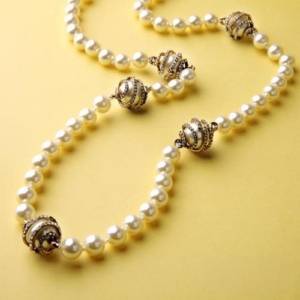
For daily wear, my go-to is a 20-inch mixed strand I assembled over three years: alternating 8mm Sterling 925 Navajo beads with 5mm Tahitian keshi pearls (Pinctada Margaritifera, natural dark gray body color, peacock overtones). I had a jeweler in Tucson fabricate 20 additional silver beads to fill the gaps where I’d sourced loose keshis. The rhythm of silver-pearl-silver-pearl at exactly 1-inch intervals creates a visual cadence. The strand weighs 92 grams. It sits perfectly.
Sourcing Notes for the Collector
I source almost exclusively through three channels: direct purchases from working silversmiths who exhibit at the Heard Museum Guild Indian Fair, estate auctions with detailed provenance, and a handful of trading post owners who I’ve vetted over a decade. The secondary market for vintage navajo pearl necklaces operates largely on trust. Ask the seller four questions: What’s the total gram weight? What’s the bead diameter in millimeters? Is the cord original or re-strung? Are there any solder repairs visible under magnification?
A well-maintained strand from the 1950s will show even patination—dark gunmetal gray with subtle blue undertones, not splotchy black oxidation that screams chemical dip. Original cord brittle enough to snap under tension needs immediate re-stringing. Factor that $40 to $80 cost into your offer. Repairs on hollow beads run complex; a crushed 8mm bead cannot be reshaped without leaving hard creases in the metal. I pass on strands with more than two damaged beads unless the price reflects the flaw.
Contemporary work from active Navajo silversmiths offers an entry point. A new 24-inch 8mm strand, hand-fabricated and properly hallmarked, runs between $400 and $900 depending on the silversmith’s reputation and bead count. These pieces arrive bright and will develop patina over your lifetime. You become part of the silver’s story, which matters more to me than a shiny factory finish.
The Daily Wear Test
I shower in my daily strand. Not the vintage ones—those stay dry. But my contemporary 8mm strand stays on 24 hours, four to five days a week. Sterling 925 does not mind water. The silk cord does. After about 18 months, the knots begin to fray, the thread absorbs body oils, and the strand loses its crisp drape. I re-string annually. A bench jeweler I trust in Phoenix handles it for $55, including new 0.45mm silk in charcoal to match the developing patina.
This is the litmus test for everyday utility: can you forget you’re wearing it and still look intentional? A properly fitted strand—snug enough not to swing into your soup, long enough to clear a crew neckline—disappears into your silhouette. You catch your reflection at 3pm, see the silver resting against your collarbone, and register it as part of your body, not an accessory you put on.
I found a vintage Navajo pearl strand at an estate sale, but it has two beads that look slightly dented and the clasp is worn. Is it worth restoring, or did I waste my money?
A dented hollow bead cannot be fully restored to its original dome. A skilled silversmith can gently push out shallow dents from the interior using a curved burnisher, but the metal will always carry micro-creases. If the dents bother you, the better move is sourcing a contemporary Navajo silversmith to fabricate replacement beads that match the diameter and surface texture of the originals. Expect to pay $20 to $40 per replacement bead, plus the restringing labor. A worn clasp is a straightforward fix—a new Sterling 925 hook-and-eye fabricated and soldered onto the original end caps runs about $45. Run the math: if the strand cost you under $200 and the repairs total $150, you’re still well below the price of a comparable new commission. The patina on that vintage silver, however, is the one element you cannot duplicate. That alone often justifies the restoration.
I’ve been wearing my Navajo pearls daily for three years and the silver seems dull, almost chalky, in certain spots. Is this normal or did I ruin the finish with hairspray or lotion?
The chalky white residue you’re describing is a specific type of silver corrosion—not typical dark sulfide tarnish, but a buildup of silver chloride. Hairspray, perfume, and lotions containing aluminum chlorohydrate or stearic acid accelerate this reaction when they sit on the metal surface for hours. The fix is non-destructive: soak the strand in a solution of warm water, mild dish soap, and a tablespoon of baking soda for 10 minutes, then gently brush each bead with a soft-bristle baby toothbrush. Rinse thoroughly. Pat dry with microfiber. Do not use liquid silver dips—they strip the surface and can seep into hollow beads through microscopic seam gaps, corroding from the inside. If the chalkiness persists, a bench jeweler can lightly repolish the affected beads with a jeweler’s rouge cloth without removing the deeper patina. Going forward, put your strand on last—after hairspray, after fragrance, after moisturizer. The rule: let your chemistry set before the silver touches your skin.