The Mechanical Reality of Imitation Pearls vs Cultured Pearls
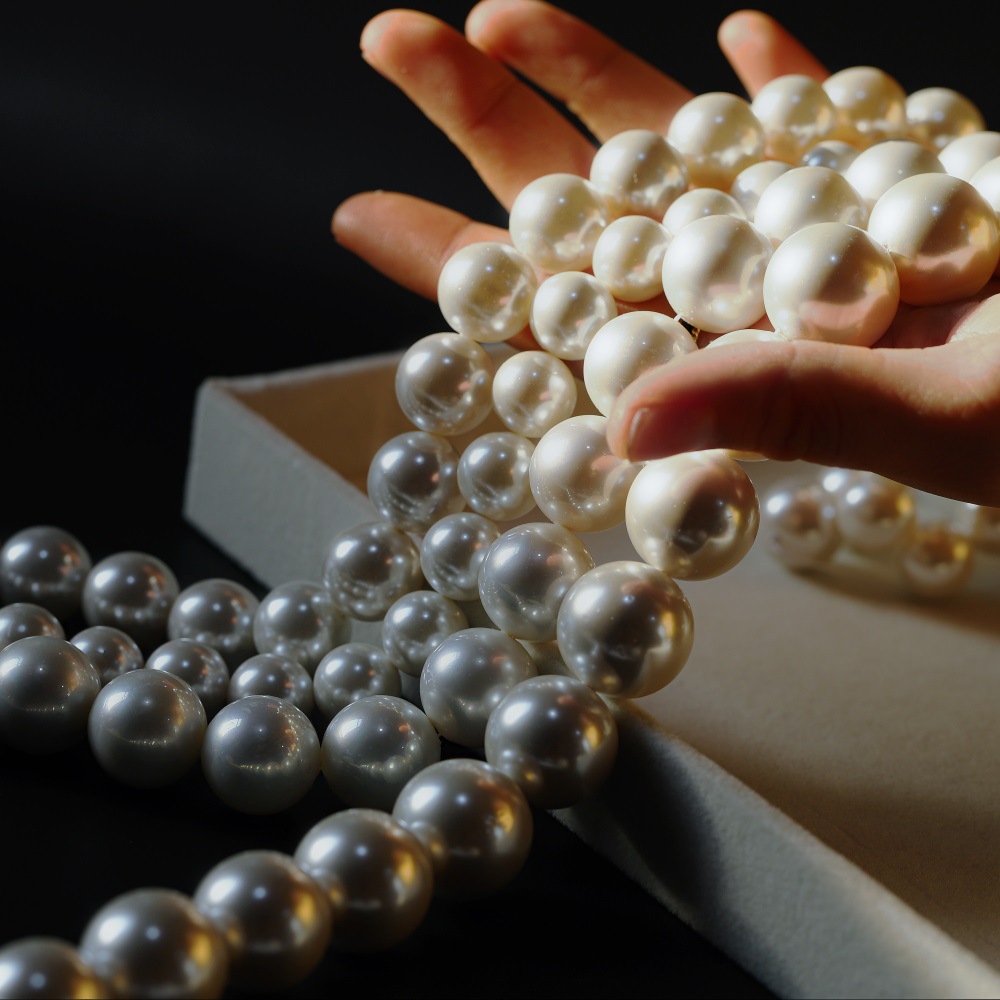
An imitation pearl weighs 1.2 grams. A South Sea cultured pearl of identical 12mm diameter sinks to 2.8 grams on a calibrated scale. The difference is a solid nucleus of Mississippi River mussel shell versus a hollow glass or plastic bead dipped in a cellulose nitrate lacquer mixed with fish scales.
The term “imitation” covers any spherical object lacking crystalline nacre platelets. Majorica pearls, the common Spanish counterfeits, use opalescent glass spheres injected with a gelatinous pearl essence called “Essence d’Orient.” Cultured pearls—whether nucleated Pinctada Maxima or beadless freshwater Hyriopsis Cumingii—deposit 0.3mm to 1.8mm of actual aragonite across 400 to 600 concentric layers. A fake has zero layers. It has paint.
The surface temperature reveals the lie instantly. Natural aragonite conducts heat at a rate of 1.3 W/(m·K). Touched to the skin of your upper lip, a real pearl surface feels cold for 2 to 3 seconds before equalizing to body temperature. A Majorica bead reaches thermal equilibrium in under 1 second. Shell-derived nuclei inside Akoya pearls (Pinctada Fucata) maintain that cold-tooth sensation pressing gently against an incisor. Plastic-coated fakes feel warm. No grit. No resistance.
The Grit Feel and Layer Structure Under 10x Loupe
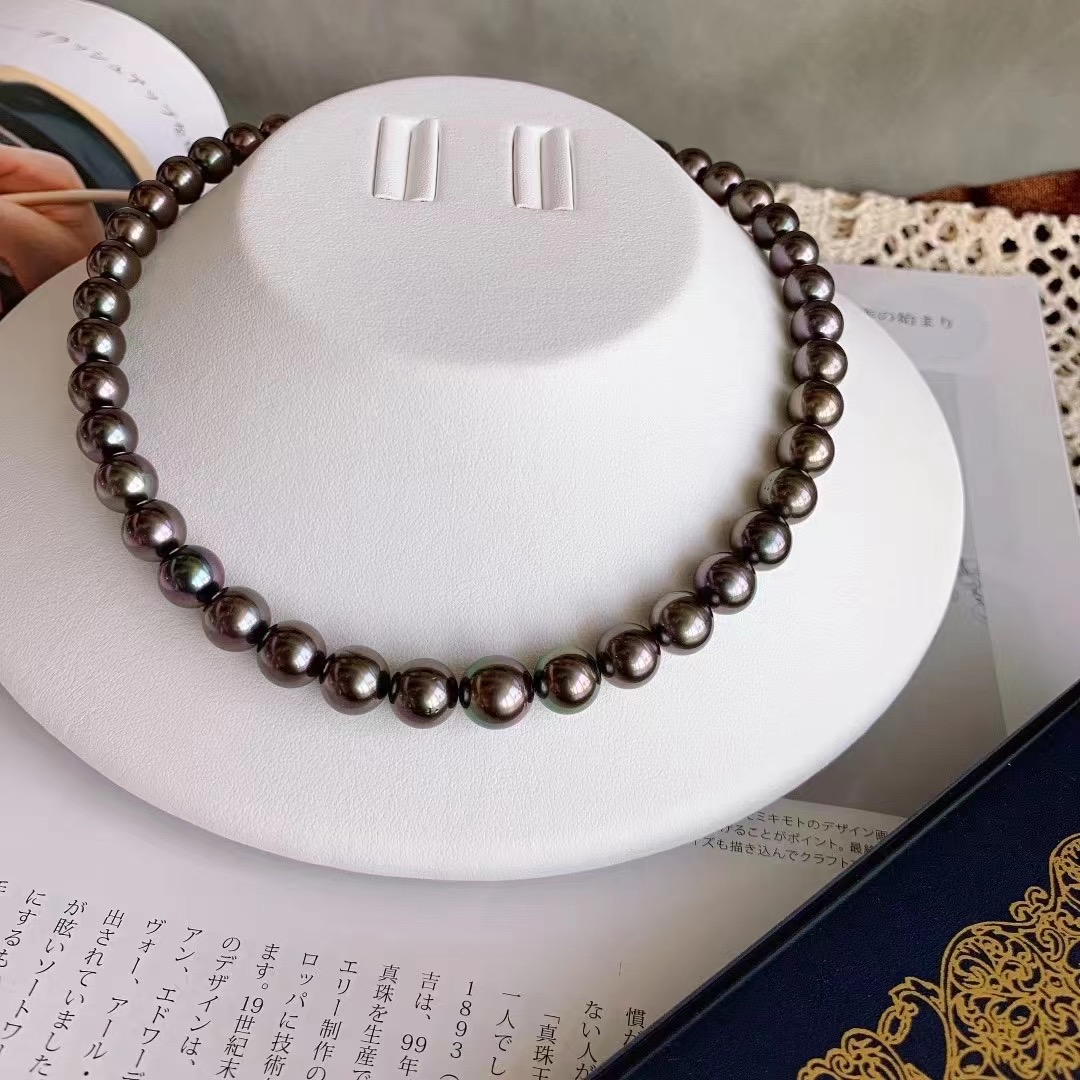
Run a 12-millimeter Tahitian cultured pearl (Pinctada Margaritifera) at 45 degrees across the biting edge of your front incisor. Aragonite platelets, deposited at 0.3 to 0.5 microns per layer, create microscopic plate boundaries. Your tooth enamel detects these edges as a fine, sandy resistance. This is the real pearl grit test, and the sensation is unmistakable. A fake slides smooth. Glass or resin offers zero crystalline friction.
Under a 10x loupe, the visual signature splits into two distinct patterns. Natural nacre displays a platy-granular surface. You see overlapping, irregular polygons—often 40 to 60 microns across—like aerial photographs of mud cracks. Imitation pearls, even high-quality Majoricas, exhibit a uniform, featureless plane. Some show tiny dimples where the lacquer shrank during curing. Magnify the drill hole of a 10mm Akoya with 0.6mm nacre thickness, and you spot a sharp transition line between the white nacre sleeve and the dark brown conchiolin layer above the bead nucleus. An imitation shows solid, homogenous material. No layers. No distinction.
Drill-Hole Inspection: The 0.45mm Gateway Biomarker
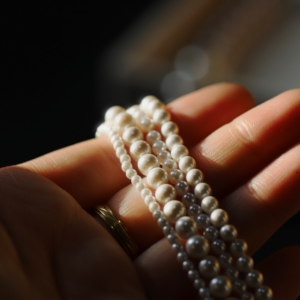
The strung drill holes clocking 0.8mm to 1.2mm diameter in finished strands are diagnostic goldmines. Real pearls, after drilling by a 0.9mm diamond-tipped bit spinning at 14,000 RPM, reveal residual nacre dust—a chalky white powder that clings to the thread. Imitations leave a curled plastic burr or sharp glass flake, often with paint peeling around the rim.
Threading matters. A 925 Sterling silver wire at 0.4mm thickness, common in single-pearl pendants, will wear the nacre edge of a cultured pearl into a soft chamfer over time. Imitation pearls—especially plastic-core types—will split or crack along the drill rim within 18 months of daily wear. The metal cuts into the resin. You see gray or beige base material where the coating fractured away.
Silk thread standards for Akoya strands use 0.45mm two-ply silk with a breaking strength of 14 lbs. When a knot is placed between genuine 8mm Akoya pearls, the nacre grips the thread. The silk bites. Imitation pearls spin freely on the thread because the internal bore is slick, lacking the microscopic roughness of nacreous aragonite platelets. That spin—that unnaturally fast rotation between two beads—is a dead giveaway before you even lift the strand.
Specific Gravity Testing and Refractive Index Parameters
Nacre density runs 2.65 to 2.78 g/cm³ depending on organic matrix content. A natural saltwater pearl from Pinctada Radiata sinks in a 2.72 g/cm³ testing solution. Most glass imitations float or hang suspended because their density ranges from 2.4 to 2.5 g/cm³. Plastic beads fall to 1.05 to 1.2 g/cm³—a dramatic buoyancy that looks wrong immediately when dropped into a liquid medium.
The refractive index solidifies identification. Aragonite nacre reads 1.530 to 1.685—a distinct double refraction signature under a standard spectroscope. Imitation pearl lacquer, formulated with nitrocellulose and amyl acetate, produces a single refractive index of 1.51 to 1.52. This matters under directed light. A real pearl’s orient—the subtle play of refracted color from the light bouncing between aragonite layers—cannot be replicated by surface coatings. You observe a transparent depth effect. The imitation’s surface reflection stays flat and metallic because light penetrates zero microns.
X-ray fluorescence screening catches modern fakes instantly. Cultured pearls, regardless of origin, luminesce a pale yellow-green under 4-watt shortwave ultraviolet at 254 nanometers. Majorica beads emit a dead, chalky blue-white. Freshwater cultured pearls from Hyriopsis Cumingii, which constitute 95% of the market by volume, glow with a strong yellowish-green. The plastic fakes remain inert. Dark. No response.
Acoustics, Heat, and the Fingertip Friction Pulse
Drop a single 10mm cultured pearl onto a polished granite surface from 15 centimeters. A real pearl, with its 1.3mm average nacre thickness over a solid bead, produces a sharp, high-frequency tick—almost like a falling glass bead but with a truncated resonance that dies within 0.2 seconds. Imitations thud. The polymer absorbs the impact energy. The sound is a flat “tock.”
Fingertip friction offers another datapoint. A clean, dry thumb pad dragged across a real pearl’s surface encounters the microscopic platelet edges. The resistance coefficient, measured at roughly 0.4 to 0.6 on smooth nacre, feels like dragging your finger across unglazed porcelain. The imitation surface friction coefficient is lower—0.2 to 0.3—comparable to polished acrylic. It feels oily, even when completely clean of skin oils.
Thermal capacity separates the materials. A real 12mm South Sea pearl at 20°C held in a closed palm absorbs heat slowly due to the mass of the bead. After 30 seconds, it remains perceptibly cooler than the surrounding skin, especially at the contact point. A plastic imitation equalizes in under 10 seconds. The glass core imitations, ironically, stay cold due to glass’s low thermal conductivity—but they fail the grit test immediately. Combine the two checks. Cold plus grit equals nacre. Cold plus smooth equals glass. Warm plus smooth equals plastic.
Spotting Faux Pearl Jewelry in Modern Retail Settings
Modern trends of how to tell real pearls from fake for women demand rapid field-recognition tactics. Boutique lighting—often 3000K warm LED at 900 lumens—masks surface detail. The orient disappears under harsh spotlights. Move the strand to a shadowed area. Real pearls retain a soft inner glow due to subsurface light transport through the nacre layers. Imitations go dark.
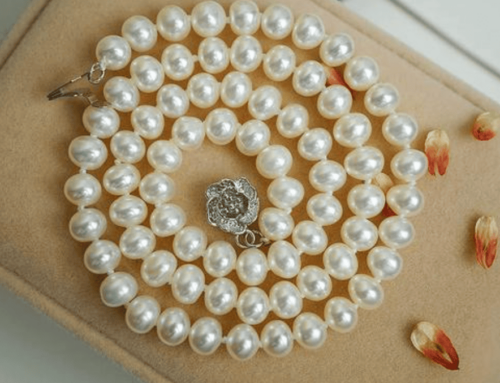
Check the clasp. A strand of genuine 8.5mm Akoya pearls, weighing 48 grams total for an 18-inch strand, requires a solid 14K or 18K gold clasp stamped with a manufacturer’s mark and karat designation. Imitation strands frequently sport unmarked gold-tone brass clasps with magnetic inserts. The weight of the clasp alone—a genuine 14K gold fishhook clasp weighs 1.8 to 2.4 grams—signals the overall quality. Brass substitutes weigh 0.8 grams. Light. Hollow-feeling.
Analyze the knotting. Genuine strands are hand-knotted with 0.4mm silk between every pearl to prevent abrasion. The knots sit tight, uniform, and occupy 0.8mm of space between beads. Machine-made imitation strands often skip knots or use oversized synthetic thread that bunches irregularly. The spacing lies. Real pearls, with their weight and value, demand the labor of an individual knotter spending 3 hours on a single 18-inch strand.
Matching, Millimeter Gradients, and the Nacre Floor Minimum
A strand of 9.0-9.5mm white South Sea cultured pearls from Pinctada Maxima displays a millimeter tolerance of 0.5mm across 35 pearls. The luster matches within a 5% variance. Imitations—mass-produced in molds—achieve perfect mechanical uniformity. Identical spheres. That perfection is its failure. Mollusks do not produce identical pearls. The slight 0.2mm deviation between pearls 14 and 15 on a strand is biological proof.
Nacre thickness dictates longevity. An Akoya pearl with 0.4mm of nacre over its bead nucleus will, under 5 years of weekly wear, show wear spots at the drill holes where the silk thread rides against the nacre edge. A Tahitian pearl with 1.8mm of Pinctada Margaritifera nacre will outlast its owner. Imitation pearls show wear in months. The coating—typically 0.05mm thick—wears through to the plastic or glass core at the friction points. The back of the pearl, resting against clothing, reveals the base material first.
Surface characteristics at 30x magnification seal the diagnosis. Nacre demonstrates growth arcs, slight ripples, and occasional tiny pits (0.1-0.3mm) where the mantle tissue retracted. These imperfections are consistent with organic deposition rates of roughly 0.6mm of aragonite per year. Imitations exhibit injection molding seams, air bubbles trapped in resin, or concentric flow lines from flame-polishing glass. The seams are often visible at the “poles” of the bead where the two mold halves met. A 0.1mm raised line circling the sphere. Nature does not produce equatorial seams.
Weight and thermal profile, drill-hole anatomy, grit test resistance, and refractive depth under loupe. Those five parameters, checked in 90 seconds, separate every imitation pearls vs cultured pearls scenario with zero ambiguity. No subjective doubt. Only material parameters responding to physical law.
Can I trust the tooth test if the pearls are strung on a necklace? Do I really bite them?
Not bite. Place the pearl between your thumb and forefinger, then gently rub or press the surface against the biting edge of a clean front incisor. The motion is a light drag at a 45-degree angle over 2-3mm of travel. You’re detecting the fine crystalline roughness—aragonite platelet edges—not biting into the nacre. A cultured Akoya with 0.6mm of nacre will register as fine-grade sandpaper against enamel. An imitation pearl will glide like polished glass. The test takes four seconds per pearl. Don’t do this over a hard floor; your grip is the safety net.
I dropped my pearl stud earring into a flame like I saw online. It smelled like burning hair. Is that conclusive?
Destructive, but the odor profile is diagnostic. Real nacre is composed of calcium carbonate platelets bonded with conchiolin—a proteinaceous organic matrix. Applying a lighter flame to the edge of a pearl for two seconds combusts the outer conchiolin, releasing a distinct singed-hair odor. The pearl surface will show a brown scorch patch that can sometimes be polished off with a jewelers’ cloth. An imitation pearl melts or ignites with a chemical, acrid smell of burning plastic or nitrocellulose lacquer. The scorch is permanent. A single 8mm freshwater pearl costs $15 to replace; the flame test is viable for junk-drawer finds you suspect are coated resin. Do not do this to a strand of 10mm Tahitians.
I wore my “pearl” bracelet in the shower once and the coating peeled off in a sheet. How did water destroy it that fast?
Your bracelet contained imitation pearls with a thermosetting resin coating applied over a glass or plastic bead. The coating thickness likely measured under 0.08mm. Hot water at 40°C, combined with soap surfactants, penetrated the micro-cracks around the drill hole rim. The resin layer—unable to bond chemically to the glass substrate—delaminated as a continuous film. Real nacre is aragonite interlocked with organic matrix through the full thickness; water cannot peel it. A genuine pearl can survive submersion indefinitely, though repeated soaking degrades the silk thread (0.45mm two-ply snaps at 7 lbs when waterlogged). The peeling sheet is absolute proof of imitation. The bracelet was not strung on silk, either—it was likely nylon monofilament, which explains why the thread didn’t swell and snap first.
Is 0.8mm of nacre thickness enough for a daily-wear pearl ring, or will it wear through to the bead?
A pearl ring set in 18K gold with a 10mm South Sea cultured pearl carrying 0.8mm of nacre sits in a high-friction environment. The exposed dome contacts desks, door handles, steering wheels. Under daily wear, aragonite nacre abrades at roughly 0.05mm per year on ring-mounted pearls. At 0.8mm, you have approximately 12 to 14 years before exposing the mussel-shell bead nucleus at the apex of the dome. Competent jewelers mitigate this by setting the pearl in a protective 6-prong mounting with the drill hole perpendicular to the finger, reducing surface exposure. Replace silk-wrapped posts annually. If the ring holds a freshwater pearl with 2.2mm of solid nacre, the wear-through timeline extends beyond 40 years. For a ring subjected to hand sanitizer and handwashing, stick to beads above 1.2mm nacre thickness—Akoya pearls average only 0.35-0.7mm and are too thin for ring use.