The Weight of Water and Light
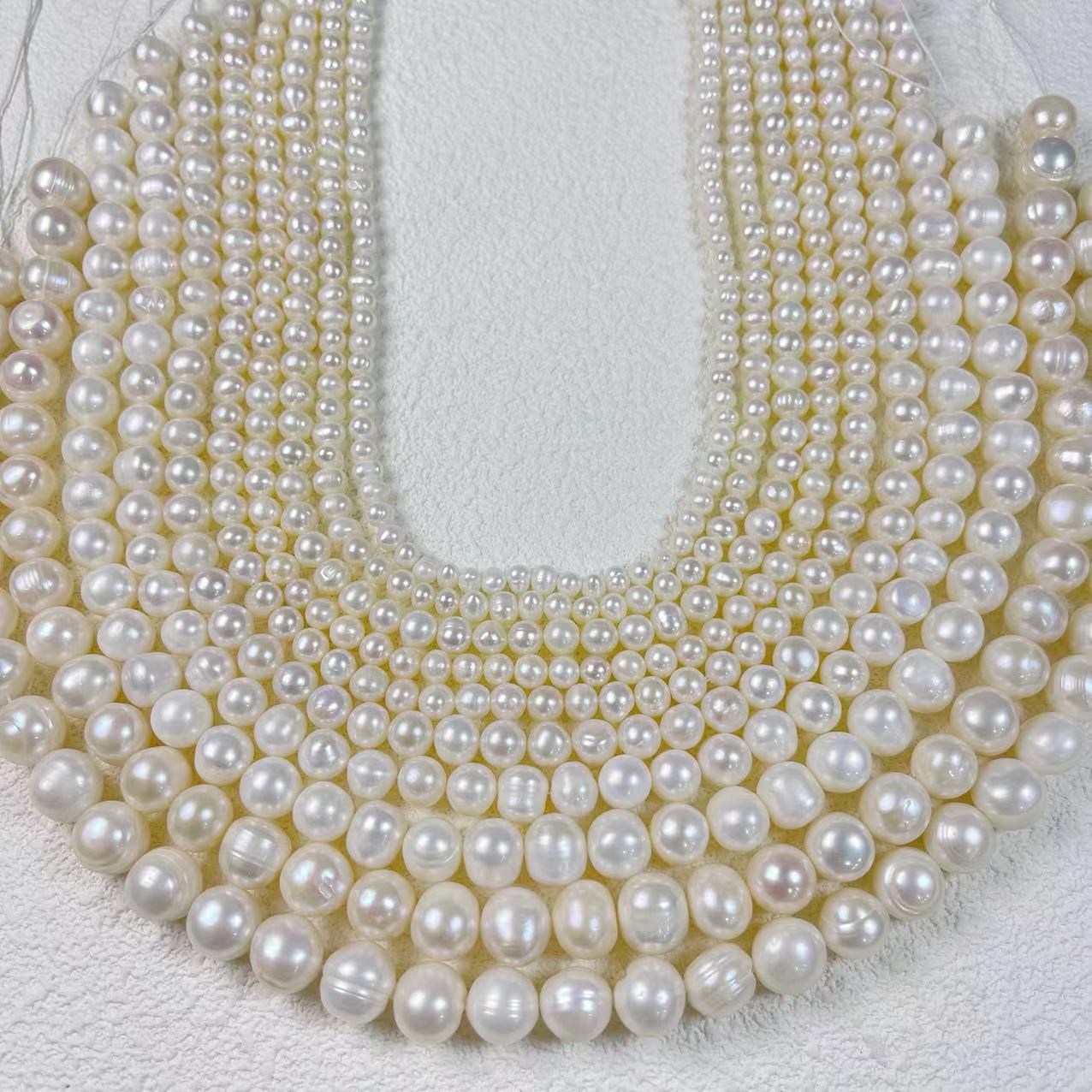
A strand of natural pastel freshwater pearls catches the light differently than anything mined from the earth. There is no crystalline fracture, just a soft, diffuse glow that seems to originate from somewhere behind the surface. That is nacre. Layered calcium carbonate, deposited slowly by the Hyriopsis cumingii mussel over 2 to 5 years. When you see a 9.0mm off-round baroque with a lavender-grey body and a faint rose overtone, you are looking at time made visible.
Affordable real pearl necklaces often get dismissed as entry-level, but I have bench-worked silver findings that cost more than a strand of these Hyriopsis cumingii gems. That is not a statement about quality—it is about market distortion. The mussel is prolific. The labor to sort, drill, and knot is becoming the true expense. A 118 cm rope of 5.5mm-6.0mm semi-rounds, hand-knotted on 0.45mm silk with a Sterling 925 fishhook clasp, weighs approximately 42 grams. That physical mass against the skin is deliberate. It signals presence.
Reading the Pearl Surface
Baroque freshwater pearls are the most honest form of this gem. They refuse to be spherical. Instead, you get elongated rice shapes, deeply dimpled drops, and button forms that ripple under a 10x loupe. Their topography tells the story of the mussel’s life—temperature shifts, mineral availability, and the slow rotation inside the soft tissue sac. I have held a 14.0mm potato pearl that felt like a river stone worn smooth, yet under magnification, its surface showed a fine dragon-skin texture. That is genuine. That is what 2.5mm of solid nacre looks like before polishing.
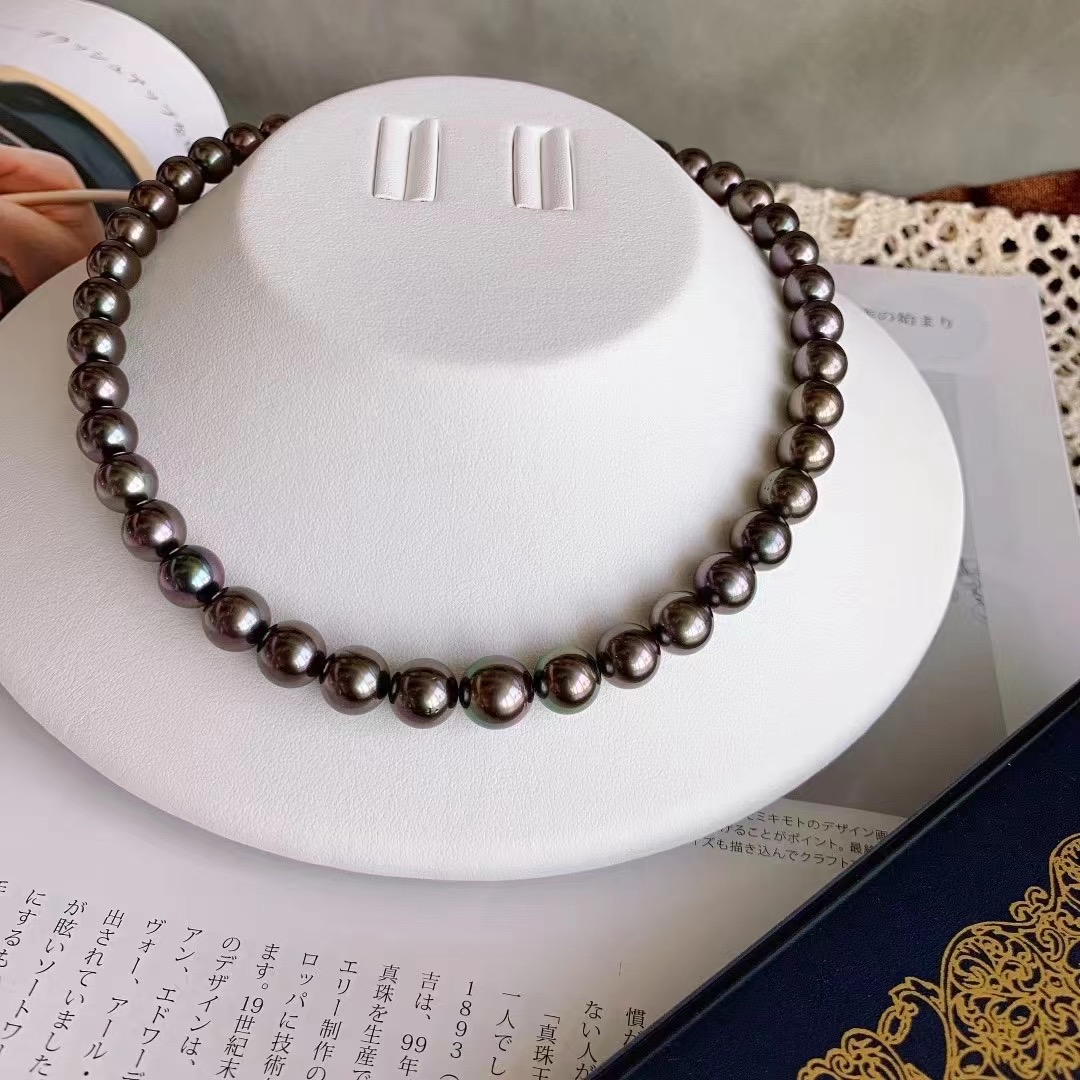
Buying genuine freshwater pearl jewelry with confidence means discarding the expectation of uniformity. If you see an 18-inch strand where every pearl is a perfect 8.0mm sphere, you are looking at bead-nucleated akoya or imitation glass dipped in varnish. A true natural-luster freshwater strand will carry subtle variations: one pearl leans cream with a hint of apricot; its neighbor pulls cool with a blue-grey ghost. That is the fingerprint of the mussel.
Color and Metallic Alloy: A Bench Approach
I spent years working turquoise and coral from the Santo Domingo and Navajo traditions. In that environment, silver is king. Sterling 925. Heavy gauge. Stamped and oxidized to bring out the depth of the stone. When I approach matching freshwater pearls to metal, the same rules apply. The soft pastels of these pearls—peach, lilac, platinum-grey—react poorly to bright yellow gold. The high karat values compete, leaving the pearl looking washed out. I want an alloy that frames, not overpowers.
A 20-gauge Sterling 925 wire, lightly patinated with a dark sulfur wash, creates the exact contrast needed to make a lavender baroque pearl read as vivid. The blackened silver sits in the crevices, the high points burnished bright, and the pearl floats above it. For a warmer skin tone, I might move to 18K rose gold, but only if the pearl body holds a strong apricot or peach saturation. If it is a cool silver-white pearl, the rose gold turns the entire composition muddy.
| Pearl Type | Diameter (mm) | Approx. Strand Weight (g) | Nacre Thickness (mm) | Recommended Findings Alloy |
|---|---|---|---|---|
| Semi-Round Classic | 7.0 – 8.0 | 38 (18-inch strand) | 1.5 – 2.2 | Sterling 925, bright finish |
| Baroque Rice | 5.0 – 12.0 | 45 (22-inch strand) | 2.0 – 3.0+ | Oxidized Sterling 925 |
| Button Pastel Mix | 9.0 – 11.0 | 52 (18-inch strand) | 2.5 – 3.5 | 18K Rose Gold or 14K Yellow |
| Keshi (Petals) | 4.0 – 14.0 | Varies greatly | Solid nacre (100%) | Hand-forged 20-gauge Silver |
Layering Mechanics: Weight and Wear
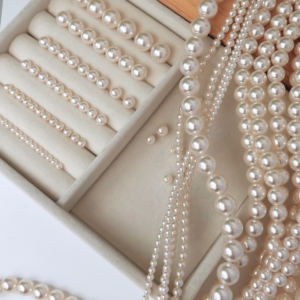
Layering is not purely aesthetic. It is physics. A 5.0mm rice pearl rope at 48 inches doubles beautifully, but if you layer it with a choker of 10.0mm buttons, the choker’s weight—around 55 grams—will pull the silk thread of the finer rope, abrading it against the clavicle. I knot between every pearl with a double silk pass, leaving a 1.5mm gap between each. That gap allows the strands to articulate without grinding nacre against nacre. Pearls are rated at just 2.5-4.5 on the Mohs hardness scale. They are soft. They demand space.
A 36-inch strand of 7.0mm-8.0mm semi-rounds, twisted once, creates a torque effect that locks the piece close to the throat. From here, you can hang a longer chain with a single 13.0mm baroque drop. The drop needs to be capped. I prefer a Sterling 925 cap with a closed bail, chemically bonded, not glued. The difference is audible. A glued cap sounds dull when tapped. A properly set cap rings with a faint, high-frequency ping.
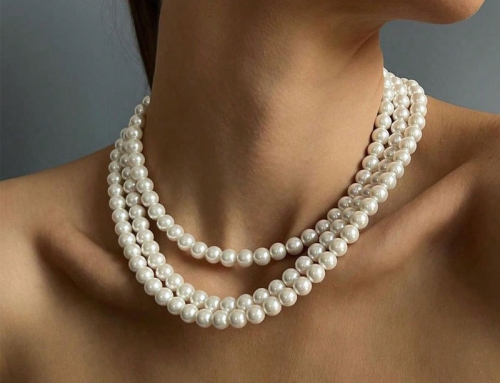
Natural pastel freshwater pearls in a multi-strand twist create a depth of color that a single strand cannot achieve. The peach tones reflect into the lavender, creating a tertiary warmth. The silver-grey pearls cool the entire composition, preventing it from becoming overtly sweet. This is the same color theory I use when laying out a squash blossom necklace: the stones must converse, not shout over each other.
The Test of a Good Strand
There is a tactile ritual to verifying a strand before purchase. The silk knots between each pearl should be firm, not loose. Loose knots mean the threader rushed. A strand with tight, uniform knots will drape with a liquid weight. Hold it by the clasp and let it hang. It should form a gentle, continuous curve. If it kinks or holds sharp angles, the drill holes are misaligned. Pearls are drilled at 0.7mm to 0.8mm, barely wider than the 0.45mm silk. If the hole is off-center by even 0.3mm, the geometry of the entire strand fights itself.
Examine the overtone. Not the body color—that is the base cream, white, or lavender. The overtone is the translucent shimmer hovering above the surface. A freshwater pearl from Hyriopsis cumingii often carries a distinct rose or aqua overtone. Rotating the pearl under a single light source should reveal this glow shifting, not disappearing. If the pearl looks chalky and flat at any angle, the nacre is too thin. That means accelerated culturing, often under 12 months, producing nacre under 0.5mm. It will wear through to the aragonite platelet layer within a few years of regular wear. Do not settle for thin nacre.
Pairing with Silver Craft Traditions
I have set countless turquoise cabochons from the American Southwest—Kingman, Sleeping Beauty, Royston. Those stones have a hardness of 5-6 Mohs, just slightly above pearl. The old silversmiths knew not to force the stone against the bezels. They allowed the silver to fold over with gentle pressure, respecting the matrix. Freshwater pearls demand the same reverence. A bezel-set ring using an 11.0mm button pearl must have a seat carved to match the pearl’s specific base contour. Pouring epoxy into a generic round cup and pressing the pearl in is a shortcut that fails within a year, the nacre separating from the chemical adhesive.
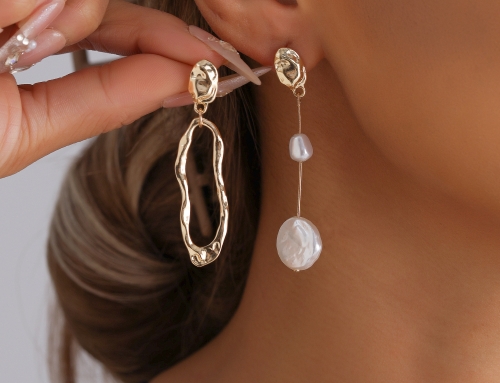
A baroque drop earring, hung from a hand-forged Sterling ear hook, should swing with a low center of gravity. The pearl’s deformation is not hidden but celebrated. A 14.0mm baroque with deep pits and storm-grey tones, mounted simply on 20-gauge wire, holds the same raw dignity as a chunk of natural turquoise still wearing its host rock. Surface complexity is not a flaw. It is evidence of origin.
The Myth of the Perfectly Round Freshwater Pearl
There is a pervasive belief that round equals quality. The bead-nucleated akoya and South Sea Pinctada Maxima pearls produce roundness because they form over a perfectly spherical bead. Traditional Hyriopsis cumingii tissue-nucleated pearls grow from a tiny piece of mantle tissue. There is no sphere to guide them. The result is an organic shape. Achieving a true 8.0mm sphere from a freshwater mussel requires many harvests and heavy sorting. That is why a strand of perfectly matched rounds commands a higher price—the rejection rate is immense.
Baroque freshwater pearls offer a way into high nacre quality without the roundness premium. A twisted baroque strand with nacre exceeding 3.0mm will outlast a thin-nacre round strand by decades. The structural integrity sits entirely in that nacre thickness. When I file into a baroque pearl to check its cross-section—something I do only with damaged pearls destined for destruction—I see dense, concentric rings, like a tree’s growth record. That density catches light and bends it through the aragonite layers. That is the luster we prize. It comes from thickness and crystal alignment, not from geometric perfection.
From Water to Skin: A Setup Routine
Pearls are porous. They absorb. Before a long wear, I avoid placing them directly on skin that has been treated with lotions, perfumes, or hair spray. The ethanol and solvents in these products dull nacre over time. I recommend dressing first, applying scent to pulse points away from the neck, and placing the pearls on last. At the end of wear, a wipe with a clean, dry microfiber cloth removes the faint acidic residue of perspiration. No water. No jewelry dips. The silk core thread swells if wet, stretching and eventually rotting. A strand knotted on 0.45mm pure silk can last decades if kept dry. Soaked once in chlorinated pool water, and you start seeing dark spots around the drill holes within weeks.
Storage matters. A leather pouch, soft but untreated, allows the pearls to breathe while preventing surface scratches. Storing them in an airtight plastic bag traps residual moisture and leads to cracks in the nacre’s concentric layers—a damage pattern known in old turquoise stones as “crazing.” The same process afflicts pearls.
Embracing Lineage
There is a reason the finest southwestern silverwork often incorporates coral, turquoise, and shell. These are materials that feel alive. They change. They record their environment. A strand of natural pastel freshwater pearls darkens slightly over years of wear, its silk interior absorbing the faintest trace of oils, the outer nacre burnishing to a deeper luster from the friction of wool sweaters and the brush of hair. That patina is not depreciation. It is a continuation of the pearl’s own growth story.
Keshi pearls, small petal-shaped forms of solid nacre, are the rawest expression of this. They form accidentally, without a nucleus, composed entirely of aragonite platelets. Drilling a 0.7mm hole through an irregular 5.0mm keshi requires a steady hand and a sharp diamond bit running at low speed. The pearl vibrates. If I push too fast, it chips. That slow pace, that respect for the fragility of the material, is what links bench jeweler work across cultures. The Navajo silversmith shaping a heavy silver cuff with a single turquoise stone operates with the same deliberate caution I use when setting a delicate pearl into a Sterling 925 ring. Force shatters. Patience holds.
Affordable real pearl necklaces, chosen with an eye for thick nacre, firm knots, and genuine metallic overtone, deliver the visual mass and texture of far more expensive jewelry. The difference lies not in the initial gleam—any polished sphere gleams—but in the persistence of that glow over time. Thin-nacre pearls go matte. Genuine, thick-nacre baroque freshwater pearls deepen. They accept the wearer’s life, mark by mark.
I layered my freshwater strand with a heavy silver squash blossom, and the knots look fuzzy after a month. Is the silk failing?
The friction between the heavy silver beads of a squash blossom necklace and the silk knots on your freshwater strand is the culprit. Silver edges, even smooth ones, act like a fine file over time. The 0.45mm silk is fraying at the knots. You need a protective barrier, like a thin leather or felt spacer between the two necklaces where they make contact at the back of the neck. You can also have a jeweler re-knot the strand with a thicker, waxed silk thread, which has better abrasion resistance. The fuzziness is a warning sign before the knot snaps entirely, so address it now.
I wore my freshwater pearls in the shower a few times and now they feel gritty and look cloudy. Can this be reversed?
Shower water, combined with soap residue, has stripped the outer luster and likely begun to degrade the silk core. The gritty feeling is etching on the nacre surface—calcium carbonate reacts with even mild acids found in soaps and shampoos. This is permanent micro-pitting. No polish can restore it without removing more nacre. The cloudiness is the roughened surface scattering light instead of reflecting it. The strand must be completely dried, the silk core replaced, and the pearls gently wiped. The damage to the nacre’s outer layers is done, but you can stop further deterioration by keeping them strictly away from water.
Why would I choose a baroque freshwater strand over a perfectly round one that costs the same?
At the same price, the baroque strand almost certainly has thicker nacre. The round strand’s cost went into the sorting labor to eliminate every off-shape pearl, often sacrificing nacre thickness because the fastest-grown, thinnest-nacre pearls are easier to find in round shapes. A baroque pearl, especially a heavily wrinkled potato or rice shape, often grew undisturbed for 3-5 years, building 2.5mm to 3.0mm of solid nacre. That thickness translates to deeper luster and a wear life that can exceed 20 years, while the thin-nacre round might show chalky wear-through at the drill holes after 2-3 years of regular use. You are paying for durability and optical depth, not just shape.
The pastel colors in my strand are fading along the edges near the clasp. Is this normal for dyed pearls?
The fading concentrated near the clasp strongly suggests the pearls are dyed and the dye is reacting to localized wear or moisture. Natural pastel color in freshwater pearls, driven by trace elements like manganese, does not fade in a band—it is body color, present through the entire nacre depth. A dye, however, penetrates only the outer layers. Friction from the clasp hook rubbing during wear can physically remove this thin dyed layer, revealing the natural grey or cream base underneath. A genuine, undyed lavender or peach freshwater pearl will keep its color uniformly. Test a single pearl from the strand if possible: a cotton swab with acetone rubbed on an inconspicuous area will lift dye but won’t affect natural color.