The Problem with “Classic” Pearl Necklaces
Most legacy jewelers sell you a single pearl pendant at a 400% to 800% markup. They wrap inferior 7.0mm freshwater tissue-nucleated pearls in 14K gold-filled chains and call it heritage. You are paying for their Fifth Avenue rent, not the pearl.
I dissect supplier invoices daily. A high-luster 10.0mm White South Sea pearl (Pinctada Maxima, saltwater, from the Australian unregulated zones) with a clean surface, thick nacre of 2.5mm or more, costs a fine jeweler roughly $180 to $350 at wholesale. They mount it on a 0.85mm 18K yellow gold trace chain weighing 3.2 grams. Total material cost: $480. Retail price? Often $2,200.
Stop it. A daily wear pearl necklace should not require a loan. The modern trends of single pearl pendant for women demand transparency. It demands raw craft. Here is the bench guide to buying, maintaining, and styling the piece you will wear harder than your wedding band.
Buying Math: Nacre vs. Nucleus
The difference between a cheap freshwater blister and a heirloom saltwater pendant is not just the price. It is the nacre thickness. This matters for a minimalist pearl solitaire pendant that touches your skin, sweat, and perfume daily.
Cheap freshwater pearls use a 8.0mm shell bead nucleus. They coat it with 0.3mm to 0.6mm of nacre. Five years of daily wear eats through that. You will expose the dull chalk bead underneath. The pendant dies. You throw it away.
A thick-nacre Pinctada Margaritifera (Tahitian) or cold-water Japanese Akoya survives. Look for these hard specs when buying an everyday single pearl necklace:
| Pearl Type | Ideal Diameter (mm) | Min. Nacre Thickness (mm) | Surface Grade | Drill Hole Depth (mm) | Backing Metal |
|---|---|---|---|---|---|
| Akoya (Cold Water) | 7.5mm – 9.0mm | 0.4mm | AA (95% clean) | 2.5mm half-drilled | 18K Yellow Gold Peg |
| South Sea (White) | 10.0mm – 13.0mm | 2.0mm – 3.0mm | A+ (Matte spots allowed on back) | 3.0mm half-drilled | Argentium 935 Silver Bezel |
| Tahitian (Dark) | 9.0mm – 11.0mm | 1.5mm | B (Minor pitting) | 2.8mm half-drilled | Sterling 925 with Rhodium Flash |
| Freshwater (Edison) | 12.0mm – 14.0mm | Solid Nacre (No Nucleus) | Clean | Full-drilled 0.8mm pass | 24-gauge Brass Core Cap |
That table is your insurance policy. Do not buy a daily wear pearl necklace without knowing the metal peg thread gauge. A 0.45mm gold peg is standard. Any thinner, and the pearl shears off the post when you catch it on a wool sweater.
Styling Logic: Why Solitude Works
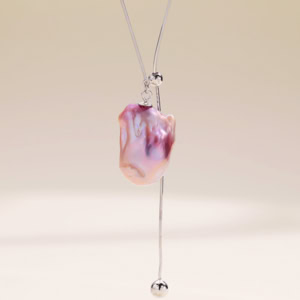
Trends cycle. Statement collars fade. The single pearl pendant stays because it solves a physical problem: it reduces friction. A cluster necklace never sits flat under a collared shirt. A solitaire does.
Here is the modern bench approach to styling a minimalist pearl solitaire pendant.
1. The Fixed Slider, Not the Jump Ring
Throw away the 0.6mm spring clasp with a fragile 0.3mm jump ring. It breaks within 800 open/close cycles. For a modern single pearl pendant, request a 1.2mm thick solid gold lobster clasp connected via a welded ring. No joints. No weak points. Pair it with a 1.0mm Box chain. It catches zero hair. It weighs approximately 2.8 grams per 18 inches. It glides. For an everyday single pearl necklace at 18 inches (45.7cm), the chain weight should be a minimum of 2.5 grams in solid 14K gold. Anything lighter is hollow—or garbage.
2. The Collarbone Strike Point
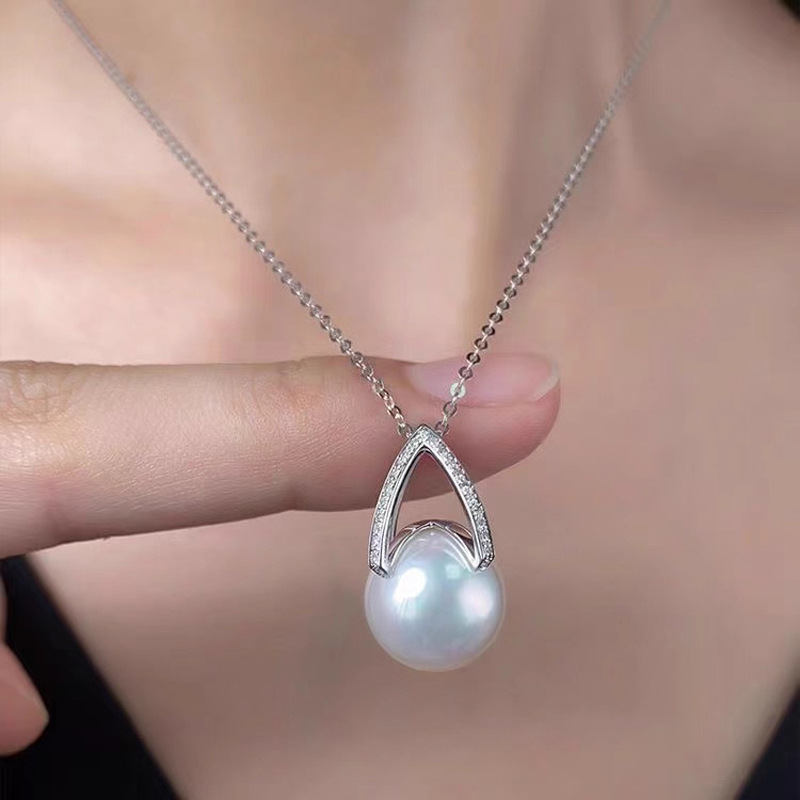
Adjust the chain to 16 inches (40.6cm). This places the 9.0mm Akoya right in the suprasternal notch. It catches light when you speak. It stays above the neckline of a standard Gildan Heavy Cotton t-shirt. It does not swing into your soup. It works. For a larger South Sea minimalist pearl solitaire pendant—say, 12.0mm—drop it to 20 inches (50.8cm). The weight of the heavy nacre (up to 4.5 carats equivalent) requires gravity to sit correctly. Short chains flip heavy pendants.
3. Metal Mismatch: The New Rule
Forget matchy-matchy earrings. The modern trends of single pearl pendant for women clash the metal base. Pair a cool white Akoya pearl with a 2.0mm width oxidized Sterling 925 chain. The black silver oxidization bleeds into the pearl’s pink overtone, making the orient pop. Cold metrics: A rhodium-flashed Silver 925 trace chain costs $12 to manufacture. Markup from a direct supplier should be 3x, not 15x. You pay $40, not $300.
Hard Wear Guide: Surfing in Pinctada Maxima
Pearls are organic. They are calcium carbonate plates bound by conchiolin. They consist of aragonite crystals. They rank only 2.5 to 4.5 on the Mohs hardness scale. A diamond is 10. Your kitchen granite counter top is a 7. Wipe your pearl across granite once, and you gouge the nacre permanently.
Yet, I wear a 10.0mm Australian Pinctada Maxima daily. I shower with it. I sleep in it. Why? Water actually preserves the luster. Dehydration kills pearls. Sealed bank vaults dry them out, causing crazing (micro-fractures).
Rules for a bulletproof daily wear pearl necklace:
- Perfume Toxicity: Ethanol dissolves conchiolin. Spray fragrance on wrists/nape 10 minutes before the necklace touches skin. Dry time is mandatory.
- Thread Rehydration: If strung on silk (specifically Griffin 100% silk, 0.45mm diameter), shower steam keeps the strand taut. Without moisture, silk becomes brittle. It snaps at a tension of 2.5 lbs. A fresh strand holds 12 lbs.
- Sweat pH: Human sweat is pH 4.5 to 7.0. Acidic sweat erodes luster over 24 months. Wipe the pendant down monthly with a microfiber cloth containing no nylon bristle. Just pure 100% polyester filament. No soap.
Anecdote: A client wore a 9.5mm Tahitian single pearl pendant on a 1.2mm siliconized necklace (a “rubber” loop, hardness Shore A 70). She never took it off for 18 months. Through CrossFit. Through salt water. The pearl retained its peacock green overtone without a single scratch. The 18K yellow gold end-cap, however, dented slightly. Metal is always the failure point. The pearl survives.
Mid-Market Cost Breakdown
Let’s look at a farm-to-neck calculation for a minimalist pearl solitaire pendant with true provenance.
- Raw Nucleated Akoya (7.8mm): Harvested Ise-Shima, Japan. Export price: $45 per piece (Grade A).
- Findings: 14K Yellow Gold bezel cup (2.1g), 14K trace chain (2.5g), 18 inches. Total 14K weight: 4.6g. Melt value at $50/gram: $230.
- Labor: Bench jeweler in Kofu, Japan. 45 minutes to drill and epoxy-set. Labor cost: $35.
- Total Farm-Direct Cost: $310.
- Fair Trade Direct Price: $460 (1.5x markup).
- Traditional Retail Price: $1,850 (6x markup).
This is the reality of the everyday single pearl necklace market. You want the fair trade price. Look for suppliers who publish their wholesale GIA Pearl Identification Reports. No certificates without a lab number. No lab numbers without a hard copy.
Layering: The 0.3mm Gap Requirement
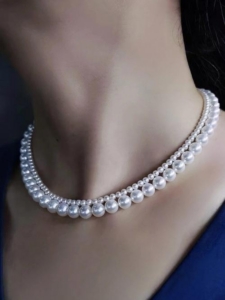
Layering chains next to a single pearl pendant causes sawing. A diamond-cut rope chain acts like a file. It slices through the soft 18K bail.
To stack a modern trends of single pearl pendant for women look, use a collar. A 14-inch (35.5cm) solid choker in a different geometric shape. Try a 1.8mm flat curb link choker in Sterling 925 without any stones. Place the pearl at 16 or 18 inches. Guarantee a 0.3mm gap between the bead-blasted metal of the curb link and the polished bail of the pendant. The gap ensures no friction welding.
Look at the physics: two gold chains vibrating together create friction at 20Hz to 50Hz during walking. Without a spacer, you lose 0.01 grams of metal per month to invisible dust. In 36 months, the bail thins. It snaps. A cheap plastic “spacer bead” fixes this. Or just use a textile cord.
The Leather Alternative
A 1.5mm round genuine leather cord in dark brown (dyed with aniline, pH neutral) offers the edgiest style for a single pearl pendant. Tie a sliding knot. Use a 10mm bead hole. The pearl sits directly against the sternum without a metal cup. This is the bare floor cost: $8 for the leather, $45 for a loose Akoya. Total creation cost: $53 plus your own hands. Designers sell this for $400. Do it yourself.
Surface Anatomy: Why “Blemished” is Beautiful
Most guides demand a perfectly clean mirror finish. Wrong. A flawless Pinctada Maxima costs $3,000. A “B” grade with one distinct pit or a slight growth ring costs $400. The luster is identical. The internal aragonite layering reflects light identically. When you wear a daily wear pearl necklace, your body heat covers the blemish with shadow. No one sees the small chalky spot on the back face.
For a single pearl pendant, request the reverse-orientation setting. Have the jeweler hide the worst surface blemish under the gold peg. Drill right into the flaw. The visible face remains flawless. Jewelers have done this for 100 years. It is the smartest buy in fine jewelry.
fAQ: Real Wearing Solutions
Q: I bought a single pearl pendant, and the silk thread broke after 2 months. Why?
The jeweler likely used a 0.25mm silk thread for a pearl heavier than 3 grams. A South Sea drop weighing 5.2 grams needs a 0.45mm thread minimum. Even better, avoid thread entirely. Use a fixed metal peg with a 2-part epoxy rated at 3,200 PSI tensile strength. It will never rot or fray.
Q: Can I wear my daily wear pearl necklace in a chlorinated pool?
Absolutely not. Chlorine concentration of 1.0 to 3.0 ppm attacks the protein matrix immediately. You will see clouding within one hour of immersion. If it happens, rinse immediately in 5.5 pH distilled water for 30 seconds.
Q: The screw on my minimal baroque pearl clasp is stuck. Solution?
Never use pliers. Submerge the clasp only (not the pearl) in a 99% isopropyl alcohol bath for 2 minutes to dissolve skin oil bindings. Twist with a rubber glove.