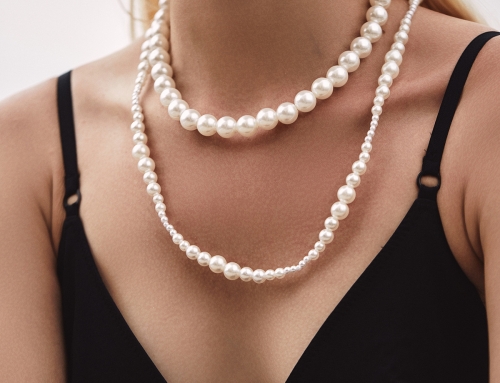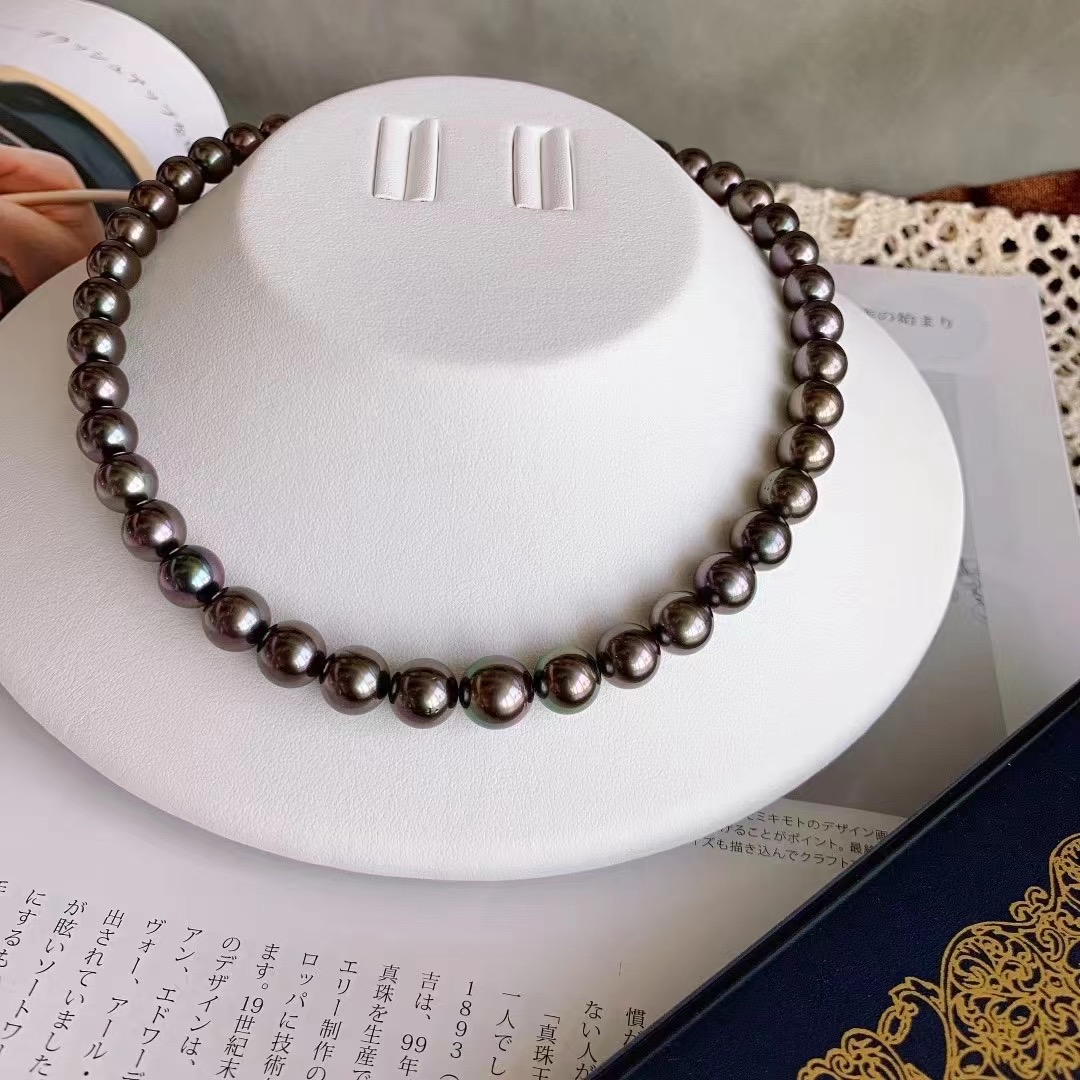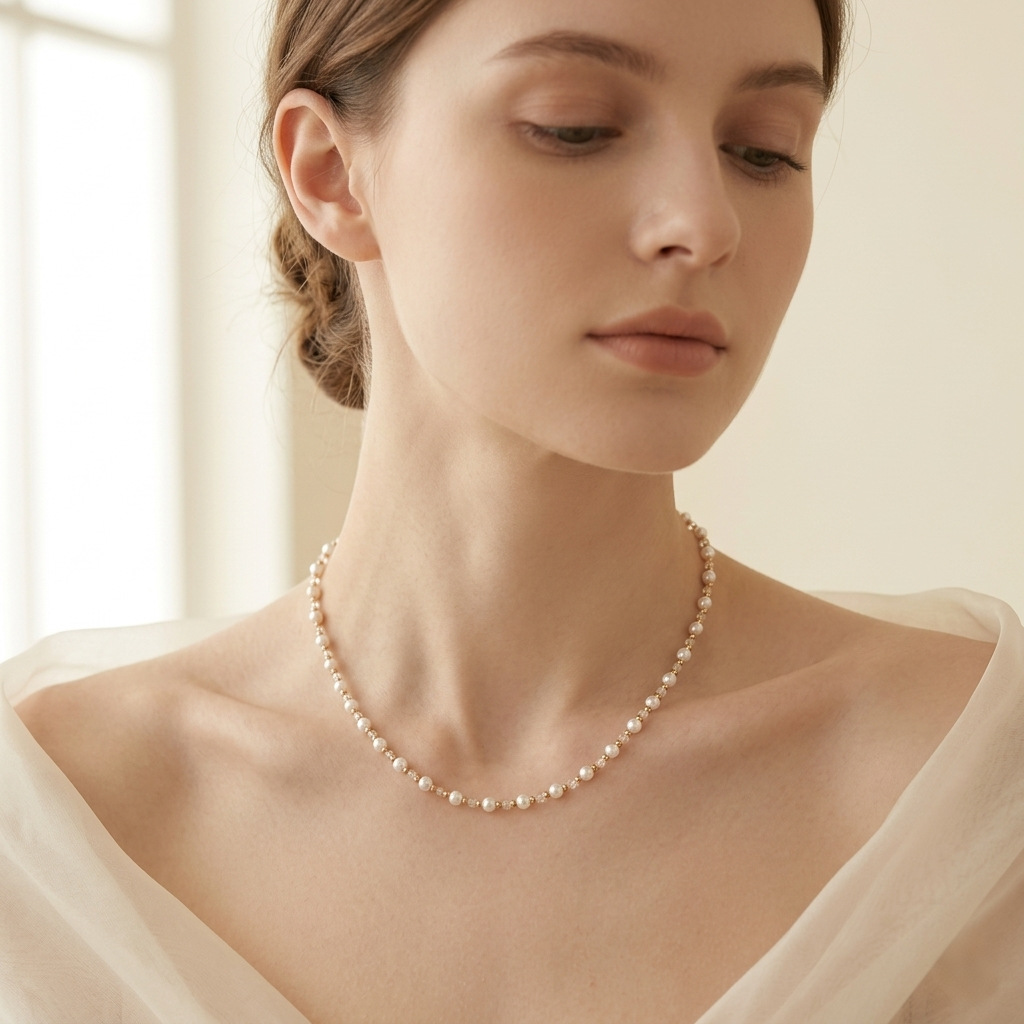
A scratched Akoya strand feels like a missed dinner party, a dress zipped only halfway. The cloudiness sits in your palm, more a relic than a radiant piece of living architecture. You aren’t looking for a museum object. You want the asymmetrical spark catching the light against a charcoal cashmere drop-shoulder sweater. Nacre isn’t stone. It doesn’t accept brute force. It responds only to archival-grade patience and the correct micro-abrasive technique.
The Soft Biology of Nacre Degradation
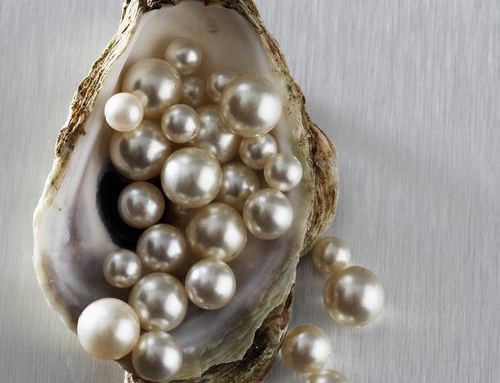
A pearl’s luster originates from layers of aragonite platelets and conchiolin arranged by Pinctada Fucata or Pinctada Maxima oysters. These translucent layers bend light like a curved mirror maze. When they dull, you aren’t seeing dirt alone—you’re seeing mechanical erosion.
The most common culprit isn’t dramatic damage. It’s chemical exposure to acidic body pH mixed with perfume atomizers. Nacre dissolves at pH levels below 5.5. A spritz of citrus cologne landing directly on a 7.5mm round button pearl creates microscopic etching within hours. Storing a single strand inside a safety deposit box for years without humidity triggers dehydration. The organic core shrinks, creating hairline cracks that refract light into flatness. You aren’t staring at a dirty pearl. You’re observing a dehydrated organic matrix.
| Specific Jewelry Piece | Exact Luster Degradation Cause | Physical Dimensions | Restoration Physical Input | Post-Restoration Alloy Compatibility |
|---|---|---|---|---|
| Tahitian (Pinctada Margaritifera) Drop Earrings | Garden party steam & chlorine vapor etching | 10.2mm x 9.8mm; 1.76g per pearl | 0.05-micron jeweler’s rouge on chamois; 2 hours hand rubbing | Re-drilled 0.85mm post hole for 18K rose gold friction back |
| South Sea (Pinctada Maxima) Strand | Dehydration in safe; cracked conchiolin | 29 pearls, 13.5mm diameter; 58.7g total strand weight | Submerged in medical-grade mineral oil; 24-hour soak | Hand-knotted on 0.45mm midnight blue Griffon silk; Sterling 925 orbit clasp |
| Vintage Akoya 3.5-Twist Tin Cup Necklace | Gold polishing compound cross-contamination | 7.5mm pearls; 16-inch 20-gauge Sterling chain; 12.4g | Acetone dip (5 seconds); ionic rinse | Chain replaced with 1.2mm box link; no chemical contact remaining |
This isn’t a visual cloud. It’s structural dissolution. We look for a loss of “orient”—the shimmer just above the surface—before we ever touch the surface with a cloth. If you can see a sharp, white chalky line running through a layer, that’s a delamination fracture. No polishing returns that. It requires a complete reset.
Cold Tactile Restoration: The Bench Mechanics
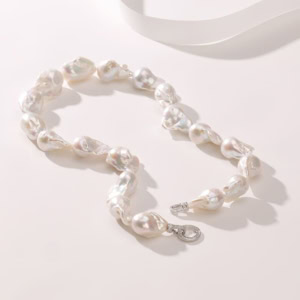
You asked, *can you fix scratched pearls?* Only if you perceive a scratch as a displacement of nacre layers rather than a groove in a solid. A pearl radiates from a nucleus outward in concentric spheres. Removing a scratch means leveling the surrounding aragonite plateau. We don’t fill. We peel back micro-layers.
For a three-millimeter superficial drag on an 8mm white Australian bead, I use a progressive grit sequence. Starting dry is a mistake. I lay a sterile microfiber cloth soaked in ionized water over my leather bench pad.
1. **Mylar film grit 12000**: draped over the pearl with gentle thumb rotation. Five rotations only.
2. **Cleanroom chamois swatch**: buffing dry to check for heat buildup. If the pearl warms your fingertip, stop. Heat denatures conchiolin.
3. **Gamblin cold wax medium**: not just for canvas. I apply a whisper-thin layer with a cotton bud tip to relubricate the platelets.
The result is a softglow—not a high-polish chrome reflection that screams “costume.” South Sea pearls with a true satiny water finish don’t need glassy reflectivity. They need depth of field.
Broken silk knots represent the silent decay of any strand. The cord stretches as it absorbs humidity from the skin, lengthening the necklace and grinding the 0.75mm drill holes against the thread core. A strand that was 16 inches in 1985 is now 18.5 inches with stretched-out gaps. Restringing doesn’t just prevent loss. It restores the precise drape of the silhouette against a collarbone or the dip of a ribbed tank top.
The Fragrance-Free Reawakening
Forget the advice about wiping pearls with a damp cloth after every wear. That introduces tap water minerals into micropores. *Professional pearl cleaning* requires thinking like a chemist, not a maid. I keep a hydration chamber in the studio: a simple sealed acrylic box with a 75% relative humidity pack. A pearl recovered from three decades of dry, wooden jewelry box incarceration goes into this chamber for seventy-two hours prior to any solvent.
Grimy silk is a different battle. If the thread is gray-brown with body oils, the luster sits underneath trapped grease. The knot absorbs oil like a wick. You can’t clean the pearl while it’s strung. I cut the thread with a surgical blade, string the liberated pearls onto a Teflon-coated needle, and space them out so they never kiss. Each pearl gets individual attention under a 10x loupe.
An oil slick of sebum dissolves with an amber jar of pure hexane on a pharmaceutical-grade non-shedding swab. I roll the swab, never rub. Rubbing embeds grime deeper. After the volatile solvent flashes off within seconds, the pearl’s original high-gloss organic skin breathes again. This is the truest form of *restoring pearl luster*—unmasking the surface that still exists perfectly intact beneath the patina of life.
The Configuration Principle: Tension & Asymmetry
Freshly restored pearls deserve a setting that matches their new energy. The modernist error is re-stringing identically to the original. The ’90s princess length choker of identical 8mm rounds feels rigid and historic. We opt for imbalance.
On a recent repair, I processed a client’s inherited Akoya strand. Only twenty-three survived the mothball corrosion. The rest exhibited chipped nuclei around the drill seam. We discarded the uniform center-strand logic. We gathered the survivors and graded them from high to low luster.
The final composition: fifteen lustrous pearls clustered asymmetrically in a 4.5-inch section at the left clavicle, separated by three-diamond-cut Sterling 925 orbit spacers weighing 0.8 grams each. The remaining eight pearls sit in a single, heavier drop on a needle-sharp 1.10mm snake chain, terminating in a rough 23K gold nugget clasp that sits exposed at the nape. The exposure is the point. The back of the neck carries its own architecture.
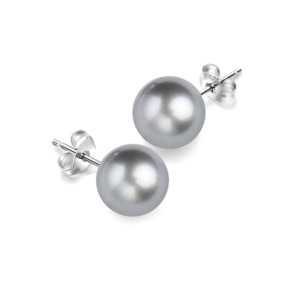
This is where I reject the entire concept of the “safe” pearl girl. A white crewneck tee demands a rough-edge setting. The irregular spaces between pearls let the skin peek through. That negative space makes the restored luster pop harder than any continuous string ever could.
Reanimating Through Controlled Oxidation
*Modern trends of restoring pearl luster for women* don’t involve high-gloss spray lacquers. They involve purposeful metal contrast. Blackened silver reacts chemically with the subtle overtone of a white pearl. The pearl pulls cool blue and lavender from the dark setting. A bright white rhodium setting forces the pearl to look yellow and clinical.
If you are *repairing cultured pearl jewelry* after a clasp failure, treat the re-design as a chance to shift the oxidation. Run a 36-gauge copper wire through a fresh-water baroque pearl’s natural crevices. The wire will develop a dark verdigris patina against the skin’s warmth. That tarnish looks like curated archaeological wear. It removes the preciousness of a “Sunday Best” pearl necklace and turns it into a daily uniform piece suitable for a waxed cotton chore coat.
The visual trick lies in the drill hole angle. Traditional Japanese knotting places the hole toward the center of the chest. I drill a secondary half-hole at a 45-degree angle to the primary bore, allowing a jump ring to pull the pearl askew. A slightly crooked pearl catches light from the ceiling and the window simultaneously. It looks liquid.
The Micro-Suction Hold
Securing a loose pearl in a bezel requires risk. A goldsmith’s torch will cook the conchiolin above 150 degrees Fahrenheit in under ten seconds. The pearl blisters white and dies. Cold connections matter. A micro-threaded screw post inserted into the reamed nucleus with a jeweler’s epoxy rated for 3000 PSI tensile strength locks the pearl without vibration.
I use a tiny neodymium magnet hidden inside a hollow-formed gold tip to capture a freshwater rice pearl in vertical drop earrings. The hold is delicate but definite. It allows you to pop the pearl off and refit it. That modularity extends the life of a restored pearl’s surface because you aren’t cleaning metal near the nacre again.
In a full-circle tin cup for a raw denim button-down, placement focuses on the peripheral. A single oversized 12mm silver-blue baroque pearl anchored just off the shoulder blade fixes the drape of a silk back panel. The thread tension matters. I use a 0.45mm Griffon silk in charcoal, pre-stretched with a 4-kilogram weight before stringing, so the necklace curves into the body rather than floating rigidly away from it.
Bench Assessment & Honest End States
After physical exfoliation, you must stabilize. A completely stripped pearl without its natural protective lipid layer absorbs whatever it touches. I seal restored pearls using a micro-droplet of archival-grade renaissance wax buffed for twenty seconds. It doesn’t build a plastic coat. It creates a hydrophobic seal that rejects perfume molecule adhesion.
Not every pearl survives the aesthetic resurrection. A deeply scratched Tahitian with 0.4mm of nacre removed becomes structurally unsound. I’ve cut such pearls in half to reveal the dead nucleus inside, then set the half-shell surgically into a wide silver band. The flat cross-section of concentric rings becomes a conversation piece in its own right.
*The Bench Recommendation:*
Wash your hands and dry them on raw linen before handling the jewelry. Inspect silk knots monthly; if the thread looks gray, book a restringing immediately. Store the piece flat in an unbuffered archival cotton pouch at 70 degrees Fahrenheit. Exfoliate surface chalk with a dry microfiber wrapped around your index finger, applying pressure no harder than you’d use to lift a single eyelash from a cheek. If the luster refuses to return because the internal aragonite layers have collapsed, authorize a bench jeweler to cut, reset, or re-nucleate. A pearl isn’t a diamond. You can re-grow its surface personality, but only if you respect the organic boundary between the oyster’s history and the open air. The real luster lies in that precise tension between a matte black oxidized hook and the moving, breathing, restored glow.