Thread, Body, and the Opening of the Oyster
Cleaning a pearl isn’t like scouring silver or buffing gold. You aren’t removing tarnish; you’re preserving a hydrated protein structure. A strand of hand-bench sterling beads with a heavy oxidized patina can take a hard polish. A 9.5mm white South Sea pearl with 2.8mm of nacre laid down by a Pinctada Maxima cannot. The skin of a pearl lives. It breathes, swells, and scars. Start by forgetting the chemical dips you might use on a 20-gauge copper cuff. Pearls rank at a mere 2.5 to 4.5 on the Mohs scale. A sharp glance from a diamond will shear the surface right off.
When a strand comes across my bench from a client who wore it to a summer wedding, I see the damage before I touch it. Perfume residue crystallizes in the drill holes. Body oils mix with talc, forming a sticky grey paste on the 0.45mm silk thread. The luster looks choked. The cleaning process begins dry, not wet. I lay the necklace out on a soft chamois, inspecting the knotting between each pearl. Those knots are sacred. In classic Navajo bead stringing, we leave spacing for the beads to roll without grinding. If the silk is frayed, no amount of cleaning saves the piece. It must be restrung. Once the thread is verified as sound, I’ll use a microfiber cloth, slightly damp with distilled water. Not tap water. Chlorine is a silent killer of conchiolin—the organic glue holding the aragonite crystals together.
Wiping Down the Aragonite Layers
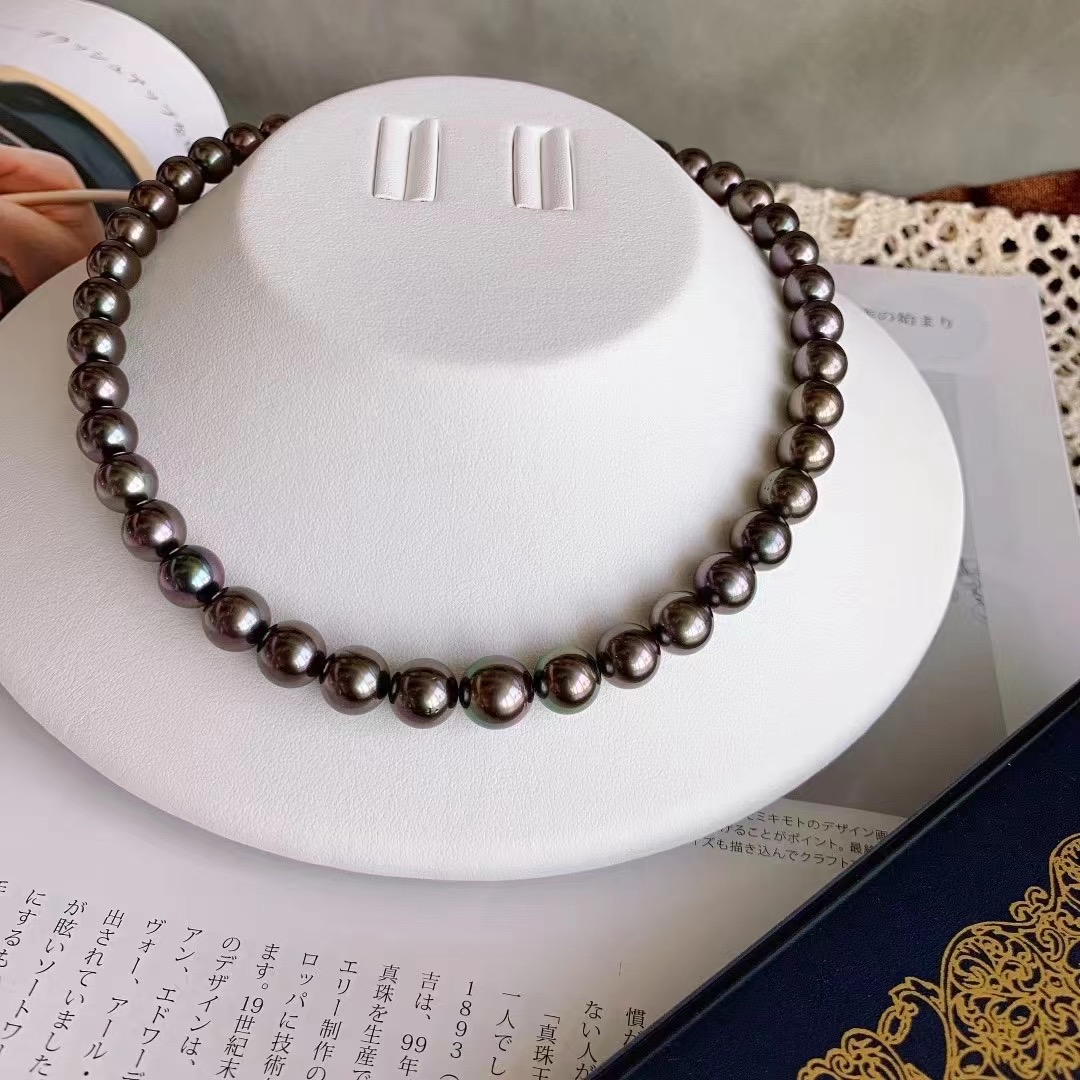
The wipe must travel in one direction. A chaotic circular scrub drives surface grit into the micro-terraces of the nacre. Imagine a 0.4mm surface scratch on a Pinctada Margaritifera Tahitian black pearl. That scratch refracts light into a dull ditch, killing the peacock-green overtone. You don’t restore that without removing nacre, which is a losing game. The goal is preservation of the original 0.8mm to 3mm of crystalline armor.
After a gentle wipe, I advocate for a bare-hands inspection. Warm hands. Not gloved. You need the sensitivity to feel for chalkiness. A healthy strand of Akoya pearls—measuring strictly 7.5mm with a tight 0.35mm thread—slides silkily through the fingers. A dehydrated strand feels hot, gritty, and loose around the drill holes. If the luster remains flat after a water wipe, I confront a common myth: the olive oil soak. Never. Oil penetrates the micro-channels in the nacre. Initially, it creates a false, greasy luster. Over months, that oil oxidizes, turns rancid, and permanently yellows the pearl body. I’ve pulled strings apart where the silk was amber-stained from rancid oil that leached through the nacre. The only acceptable post-clean luster booster is a dry, dedicated jewelry polishing cloth made for soft gems. Just a whisper of a touch burns the surface to an icy shine.
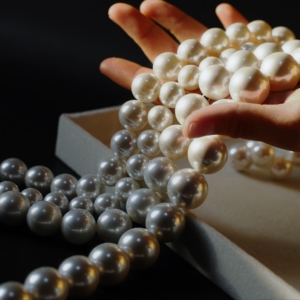
The Ethos of Storing Pearl Necklaces Flat
Here is where the western bench logic intersects with practical storage. A sterling silver and turquoise squash blossom gets hung on a padded hook to avoid crimping the silver wires. A heavy strand of 11mm Golden South Sea pearls must never hang. Gravity is a slow-acting enemy. A strand weighing 65 grams, hanging vertically for six months, stretches the 0.55mm bonded silk into a thin, brittle whistle. The knots loosen, the drill holes widen internally, and the pearls begin to click against each other, chipping the lips of the holes.
Storing pearl necklaces flat respects the structural integrity of the silk and the weight distribution. I use an antique wooden tray lined with faded blue velvet in my personal archive. No plastic bags. Plastic off-gasses and traps humidity, which rots the silk thread. Pearls need to breathe, or they dry out and crack. If they must be in a safe, place a small dish of distilled water inside to keep the environment from dropping below 40% relative humidity. Early Navajo traders who carried shell and turquoise knew this intuitively. They didn’t seal shell in boxes; they kept it wrapped in breathable trade cloth. The principle applies to your pearl care and maintenance routine. The strand must lie uncoiled, clasped, and free of any weight resting on top of it. A tangled knot is better than a snapped thread rubbing against a diamond setting.
The Peril of Ultrasonic Vibration
The bench formula is simple: intense cavitation + layered nacre = structural catastrophe. A concentrated ultrasonic cleaner generates microscopic shockwaves. These waves rip through the cleaning solution and blast against the shell layers. I’ve run a test on a 6.5mm freshwater pearl in a standard 42 kHz ultrasonic tank. Within 90 seconds, the nacre developed heat-checking resembling shattered glass—fine cracks invisible to the naked eye until they attract dirt and turn black. The intense vibration bounces the pearl against the metal basket, chipping the mouth of the drill hole.
Can you use ultrasonic cleaner on pearls? If you value the iridescence, absolutely not. The high-frequency wave travels through the soft aragonite layers faster than through the hard metal findings. Heat builds internally. The pearl can literally blister from the inside out. Only solid, un-drilled bodies of turquoise or hard gemstones with no internal fractures survive the ultrasonic tank. A pearl is a biological sandwich. Treat it as such. I always stress this to customers who bring in heirloom strands from the 1960s, caked in hairspray. The extra ten minutes it takes to clean those by hand preserves the 1.0mm of delicate nacre left after decades of wear.
Navigating Cosmetic Contact and Dehydration
Applying cosmetics, sprays, and lotions before putting on a pearl necklace is a destructive sequence absorbed by the conchiolin proteins. The alcohol in perfume vaporizes and draws water out of the aragonite crystals. This creates a matte, powdery crust. The sequence must be reversed. The strand is the last thing you put on and the first thing you take off. The ritual aligns with the Navajo spiritual practice of treating turquoise as a living entity—adornment comes after the body is prepared, and the stones are removed before engaging in the mundane grit of the day.
Sunlight, too, acts as a bleaching agent. A strand of black Tahitian pearls left on a car dashboard in the Arizona sun will fade to a sickly bronze-brown in under 40 hours. The nacre pigments oxidize. You cannot reverse UV bleaching. This is a core tenet of honest pearl care and maintenance. We are protecting the water trapped inside the organic matrix. The same discipline you use to oil a fine gunstock or condition a leather saddle applies. Be present. Wipe them down. Lay them flat in the dark cool.
How to Style How to Clean Pearl Jewelry in Daily Life
The act of wearing and cleaning merges in the styling concept. You don’t put pearls in a sterile box and forget them. Wearing them allows the body’s natural oils to hydrate the nacre gently—this is why heirloom strands develop a deep, glowing patina. The trick is integrating a 14K white gold clasp setup that allows a quick-release. If you can’t take it off easily, you won’t clean it. I design the cleaning protocol into the styling. A heavy 10mm baroque strand requires a daily wipe after wearing. A delicate 4.5mm choker needs a weekly silk inspection.
When I style a look—perhaps pairing a classic white strand with an oxidized Sterling 925 and Kingman turquoise cuff—the juxtaposition relies on textures. The silver is meant to absorb a patina; we encourage the oxidation to pool in the stamp work. The pearls must exist as a violent contrast: pure, luminous, and untouched by the tarnish. If the pearls look cloudy against the oxidized silver, they look dirty. That sharp contrast forces a disciplined maintenance routine. Wiping the pearls after every wear to keep that mirror-bright surface against the dark silver is essential. You feel the difference. The heavy feel of a 23-gauge needle-thin Sterling bead against the weightless, silky glide of a perfect 8.0mm Akoya. The ritual of cleaning—the soft cloth, the cool water, the flat storage—becomes as ingrained as taking off your boots after a long ride.
I ran my strand through an ultrasonic basket. It looks speckled and dull. Is the nacre shattered?
Very likely the cavitation has fractured the surface lamellae. When viewed under a 10x loupe, you may see tiny circular cracks or a dusty, dehydrated surface. That speckling is light trapped in fractured nacre. The damage is permanent. You can’t polish it back without removing the remaining nacre. At best, a gentle wipe with a damp cloth may remove some surface residue, but the structural heat-checking remains. That experiment cost you the mirror finish.
I wore my 9mm golden strand in the shower. It now has a visible chalk line around the drill holes. What happened?
Soap scum and hot water penetrated the thread channel. The 0.45mm silk swelled inside the restricted hole, pulling debris down into the aragonite core. As the strand cooled, the silk contracted, locking the grime into the mouth of the drill. The chalk line is mineral deposits left behind from hard water. You’ll need a bench jeweler to cut and drill out the old silk carefully, and the pearls need a meticulous pin-and-distilled-water cleaning of each hole before a fresh silk knotting. Nail polish or glue around the holes is a horror show—never attempt that.
The body color of my white freshwater pearls is turning yellow but I only wear them on special occasions. Is this the silk poisoning the nacre?
It’s less about poison and more about suffocation. If the strand was stored in a plastic bag or airtight container, the silk and protein layers couldn’t off-gas. Combined with trapped perfumes, the organic conchiolin oxidizes into an amber tone. The yellow isn’t on the surface; it’s inside the nacre layers. You can’t bleach this out without dissolving the pearl entirely. The culprit is often a hardwood drawer varnish outgassing formaldehyde, reacting slowly with the calcium carbonate. Store them only with inert fabrics like undyed cotton or acid-free silk, and keep them in circulating air.
My knotted silk has turned a rusty brown. Can I just wash the whole strand in mild soap and water?
No. Wetting a brown, rotten silk strand is a fast track to snapping it. The water acts as a lubricant, and the weight of the pearls will pull the degraded thread apart instantly, spilling them across a hard sink. That amber color is the silk’s structural failure. When it reaches that stage, it crumbles like dry-rotted leather. The strand needs dry cutting immediately. Each pearl must be wiped clean and re-strung on fresh, high-tensile bonded silk—preferably a 0.45mm thread with a fine twisted needle, double-knotted between each pearl.