What Do Pearls Symbolize? A Bench Jeweler’s Logic
I was restringing a vintage strand last Tuesday. The silk had grayed. The knots had relaxed. I held one 9.5mm Akoya under the 10x loupe. The surface wasn’t perfect. A slight dimple. A swirl in the nacre that caught the bench lamp like a fingerprint. That imperfection — the physical record of a mollusk sealing an irritant — is the only starting point for understanding what do pearls symbolize.
Symbolism without material reality is just air. At the workbench, meaning comes through tension. The 0.45mm silk thread bites into a bead knot. A 20-gauge Sterling 925 earring post slides through a half-drilled Pinctada Maxima nucleus. I smell the polishing compound, see the burnishing residue. The spiritual meaning of pearls gets grounded here, in the residue and the drill dust. Pearl resilience and strength isn’t a metaphor I read. I test it when a strand hits the maple benchtop from three feet and the nacre doesn’t crack.
The Grain Runs Deep: History in the Shell
 A Pinctada Margaritifera from French Polynesia builds 0.8mm to 1.2mm of nacre over 18 to 24 months. Layer by layer, aragonite platelets stack like microscopic brickwork. The oyster doesn’t plan a symbol. It secretes. The symbol accretes later, in human hands. Roman women wore pearls to denote rank. Chinese artisans set pearls in 22K gold hairpins during the Ming dynasty as emblems of wisdom, the gem forming over time, not found fully formed. The pearl’s meaning stemmed from this slow, stubborn accumulation — a material analogue for earned insight.
I’ve hand-sawed 18K gold bezels for baroque South Sea pearls that were 14.3mm long, 11.2mm wide. The irregular shape dictated the setting. I followed the contour with a 0.5mm flat graver, undercutting the bezel wall. The design came from the pearl’s own grain, not a template. That’s pearl jewelry with meaning: the metal conforms to the organic form, the form carries its history of layered endurance.
The Workbench Metric Log
Data grounds the symbol. Here’s a precise breakdown from a recent Akoya strand assembly. Silk gauge, knot tension, alloy composition — these numbers aren’t poetic, but they’re truthful.
| Component | Specification | Physical Note |
|---|---|---|
| Pearl Type | Japanese Akoya (Pinctada Fucata Martensii) | Cultured, 8.5-9.0mm diameter |
| Strand Length | 18 inches (45.7 cm) | 47 pearls, graduated center |
| Stringing Material | 100% natural silk, 0.45mm gauge | White, pre-stretched, 4-ply |
| Knot Tension | 0.8 – 1.0mm French wire separation | Hand-tied between each pearl, no glue |
| Clasp | Sterling 925, hand-fabricated fishhook | 6.2g, 20-gauge wire, hard solder seam |
| Total Weight | 43.7g (strand + clasp) | Measured on Ohaus triple-beam balance |
| Nacre Thickness (avg) | 0.4mm | Verified at 2 drill-hole cross-sections |
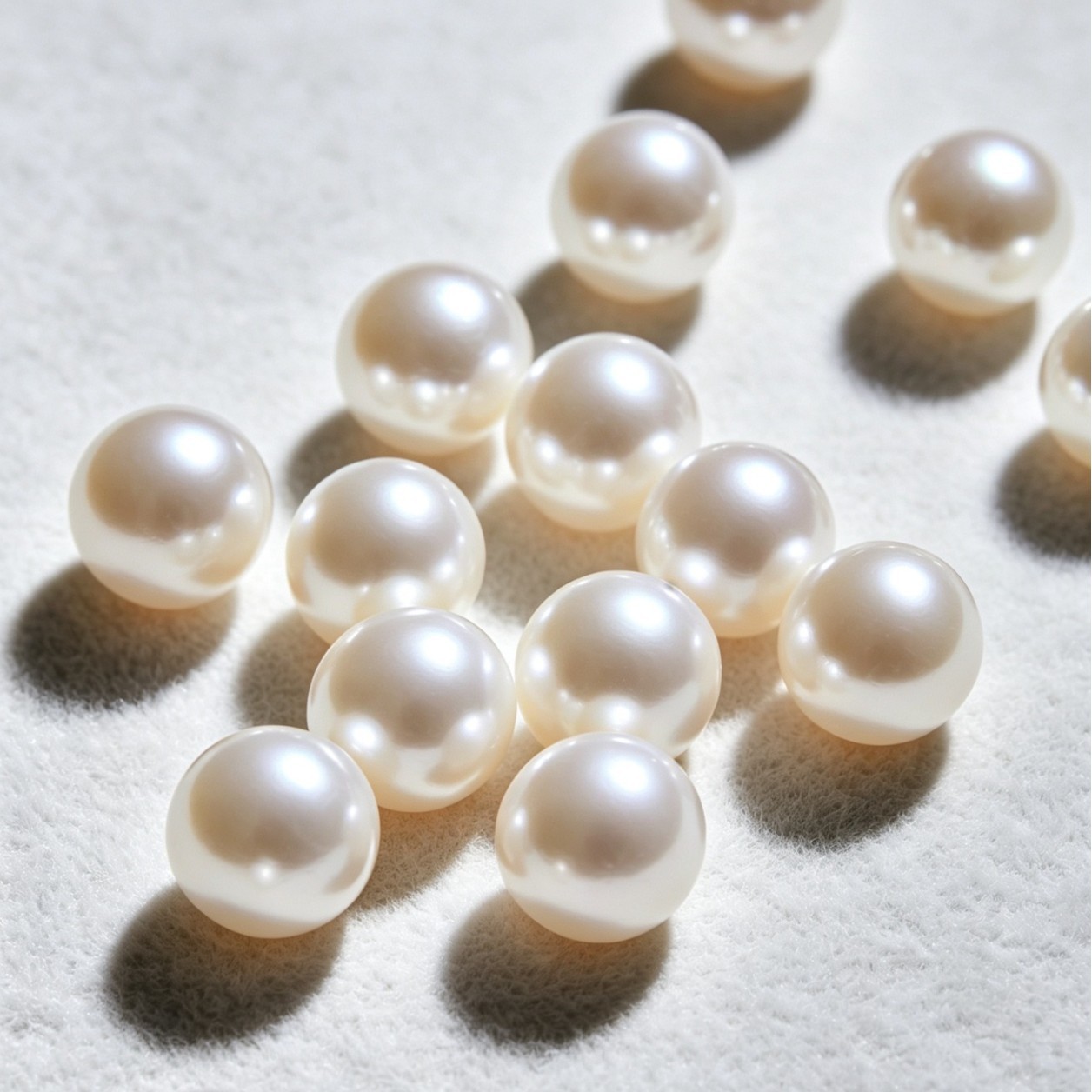
When a customer asks what do pearls symbolize, I hand them a loose 9mm Akoya. The weight is 1.1 grams. The surface is cool at 68°F ambient. They feel the nacre’s density — not “purity,” but compacted calcium carbonate. The spiritual meaning of pearls becomes tangible: resilience built in microscopic increments.
Pearl Resilience and Strength: Reading the Surface
I’ve reset pearls salvaged from estate sales where the original silk had rotted. The nacre held. Under 30x magnification, I can see the overlap of aragonite crystals, the organic matrix that binds them. This structure survives decades of skin oils, perfume micro-sprays, and temperature swings. Pearl resilience and strength is the crystal architecture of Pinctada Maxima doing its silent work.
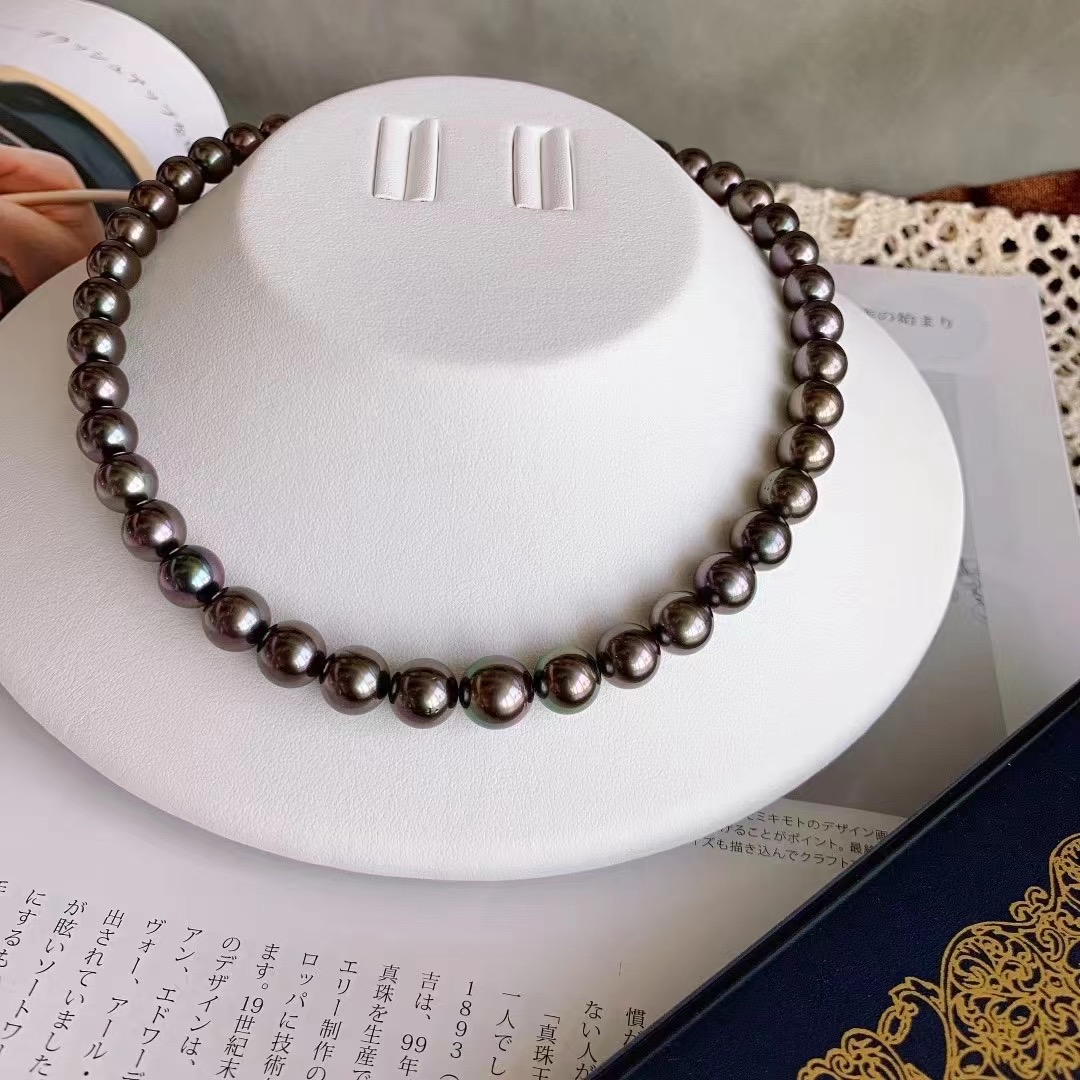
One Tahitian pearl, 11.8mm, charcoal with peacock overtones, had a 0.3mm surface scratch from a prong setting. I re-polished it with a muslin wheel and 0.5-micron diamond paste, removing maybe 0.05mm of nacre. The luster returned. The pearl endured the correction. That’s the symbol: you can lose a thin layer and still hold depth.
I see this in all genuine pearl jewelry with meaning. The clasp wears before the pearl does. The 14K yellow gold hinge on a pair of drop earrings will fatigue; the 11mm South Sea pearl it holds remains intact. The metal is the variable; the pearl is the constant.
How to Style What Do Pearls Symbolize in Daily Life
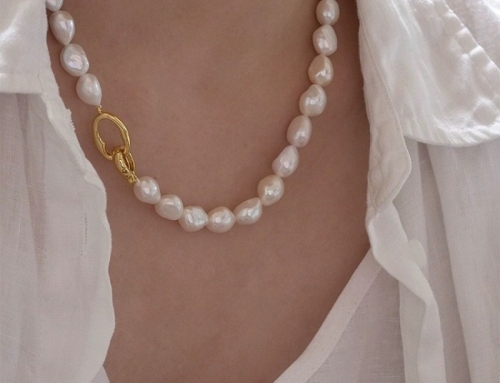
Style isn’t about “elevating.” It’s about wear. A 7.5mm Akoya strand with a 14K white gold fishhook clasp at 18 inches hangs on a cotton collar differently than a 16-inch choker of 6mm freshwater pearls with a Sterling 925 box clasp. The shorter strand warms against the skin, absorbing body heat. The longer one swings, knocks lightly against buttons.
The tension here is real. I’ve repaired a 16-inch strand where the silk abraded against a metal zipper pull. The owner wore it daily under wool. That friction, that evidence of life, is the styling that matters. How to style what do pearls symbolize in daily life? Wear them against materials that leave marks. Let the pearls survive it.
For pearl jewelry with meaning, I suggest a mixed-weight configuration. A 10mm white South Sea pendant on a 1.2mm 18K rose gold chain (16 or 18 inches). The chain’s trace links are light, the pearl’s density dominates the neckline. You feel the pearl before the metal. Alternatively, a triple-strand bracelet of 5-6mm keshi pearls, hand-strung on 0.35mm silk with a Sterling 925 pearl clasp. The irregular shapes — products of Pinctada Margaritifera rejecting a nucleus — embody resilience without a single word of branding.
Genuine Scenarios Where Pearl Jewelry With Meaning Holds
 Morning routine: You clasp an 18-inch Akoya strand at 7:15 AM. The 0.45mm silk has a slight tension, the graduated pearls settle between the clavicles. At the workbench, I’d test this strand with a 5-pound pull test. It holds. The spiritual meaning of pearls meets the pull test. You wear it through coffee, keyboard clatter, a noon walk.
Evening event: A single 12mm golden South Sea pearl (Pinctada Maxima, Philippine origin) hangs from 18K yellow gold ear wires. Total drop: 1.5 inches. The nacre’s orient shifts from champagne to silver under a chandelier’s incandescence. The 18K wire is hand-forged, 22-gauge, with a hardness that won’t deform under the pearl’s 2.3g weight.
Heirloom transfer: A grandmother’s baroque Tahitian strand needs restringing. The pearls range from 9.2mm to 12.7mm. Circlé bands stripe the surface — growth rings from seasonal changes in the atoll’s lagoon. I restring on 0.5mm silk, double-knotting with French wire at the clasp. The pearls’ meaning passes through my fingers: decades of a life, now stable on fresh knots.
The Grit
I’ve sawn Sterling 925 sheet, 0.8mm thick, into backplates for pearl pendants. The jeweler’s saw blade, size 2/0, cuts at 100 strokes per minute. The blade’s teeth catch the silver. The pearl, already drilled 0.8mm in diameter with a diamond-tipped bit under water coolant, waits for the peg. This connection — 0.8mm silver peg into 0.8mm pearl hole — is structural. The symbol works because the fit is 0.1mm tolerance. No wobble. No glue.
Pearl resilience and strength, at this scale, is measurable. The pearl’s nacre withstands the friction of the silver peg. The spiritual meaning of pearls, whatever words we attach, starts here. At the interface of drilled calcite and hand-filed metal.
No need to overstate. The work speaks. When I close a strand’s silk with a final knot, pull the thread ends into the last pearl with a curved needle, and trim the silk to a 0.5mm tail, the piece is done. Ready to be worn. Ready to accumulate its own scratches, its own history. That history — physical, measurable — is the only meaning a pearl truly holds.
I wore my strand in the shower and now the knots look fuzzy. Is the silk failing?
Yes, the water compromised the silk’s tensile strength. Natural silk, especially 0.45mm gauge used in high-end strands, absorbs moisture and swells. Over time, hot water and soap residue degrade the silk protein structure. The knots lose their compression — from a 0.8mm tight closure to a loose, fibrous-looking puff. The pearls themselves rarely suffer, but the weak point is the thread. Bring it in for a restringing. I’d strip the old silk, clean the drill holes with a 0.6mm reamer, and re-string on fresh, pre-stretched silk. Keep the new strand away from water. Wipe pearls with a dry, soft cloth after wear instead.
I bought an 11mm Tahitian pearl pendant online and the nacre is warm to the touch. Real?
Real cultured pearls feel cold at first contact — like touching a marble countertop. Imitation pearls, which are glass or plastic beads coated, warm up within 3-5 seconds. A genuine 11mm Tahitian (Pinctada Margaritifera) has 0.8mm to 1.5mm of nacre. Nacre has low thermal conductivity; it draws heat from your skin slowly. Do the tooth test: gently rub the pearl against the edge of a front tooth. Real nacre feels slightly gritty, like fine sand. Glass or plastic feels smooth. If your “pearl” warms instantly and feels smooth as a bead, you received an imitation. Real nacre’s texture is unmistakable — the same grittiness I feel under a graver when hand-setting one.