The Grit That Defines Value
Run a 10x loupe over a strand of 8mm Akoya pearls right now. The marketing photos erased those chalky divots and hairline grooves. The untouched pearl reveals a topographical map of its life inside Pinctada Fucata. A flat, glass-smooth surface is a laboratory lie. A gritty, textured epidermis is biological fact. We sort pearls by surface clarity not to find plastic perfection, but to gauge how much visual static a blemish injects into the luster.
A clean pearl—rated AAA or “Clean” by most grading houses—stops light dead in its tracks. Reflection snaps back without interruption. A heavily blemished pearl scatters photons into chalky white splinters. The surface isn’t just “damaged.” The aragonite platelets stacked in the nacre misalign. Light enters that pit and dies there. You don’t see a dot; you see a dead pixel in the gem’s glow. This isn’t abstract grading. It’s optical physics hitting 0.45mm of crystalline calcium carbonate.
Surface Architecture: How Nacre Layers Bend Reality
Blemish classification gets lazy fast. Most sellers drop four words: “dings, spots, bumps, pits.” A bench jeweler sees three distinct structural failures. Each one matters differently when you mount a 10mm South Sea pearl into a 14K yellow gold cage.
Type 1: Adhesive Drag Scars. The pearl rotated against the mollusk’s mantle during calcification. You get crescent-shaped wrinkles in the nacre. Under 30x magnification, they look like dried mud flats. These don’t crater the surface. They warp the reflection. A drill hole placed precisely at 90 degrees to the drag scar hides it against the skin. Silk thread tension at 0.35mm keeps the pearl from rotating forward again. This pearl sells at 40% below “clean” retail but performs identically when set correctly.
Type 2: Crystal Pop-Outs. A single aragonite platelet lifts during growth and snaps off. Leaves a conical pit 0.2mm to 0.8mm wide. Sharp-edged. No organic filler. This is the contamination buyers fear most. A pop-out dead-center on a 7mm Tahitian (Pinctada Margaritifera) kills the pearl for a solitaire ring. But cluster it among five heavily peacocked Tahitians in a tin-cup necklace, and each pop-out scatters light sideways into adjacent pearls. Surface flaws turn into glitter sources. I’ve drilled through pop-outs deliberately—the 20-gauge hollow needle finds the void and the sterling silver post fills it. Flaw disappears into the finding.
Type 3: Organic Matter Inclusions. Dark brown to black specks suspended in nacre layers. These are conchiolin protein pockets—the organic scaffold the oyster uses to glue aragonite crystals together. Not “dirt.” Living tissue. Under a fiber-optic light, conchiolin burns amber while surface pits stay dead. A single inclusion under 0.1mm on a 9mm white South Sea (Pinctada Maxima) is invisible at 18 inches. The eye blends it into luster’s depth. Two to three widely spaced inclusions? Still AAA consumer grade, but the pearl loses $200 per inclusion from wholesale appraisal.
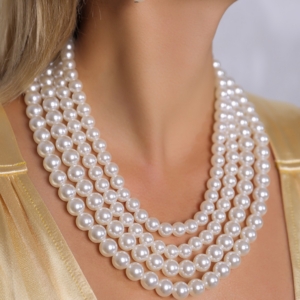
Clean vs. Charactered: A Bench Perspective
I hand-saw sterling silver bezels at 26-gauge thickness. When a pearl arrives with surface “blemishes,” I handle it with bare fingers to feel topography. A pit catches the edge of my bezel strip during burnishing. I must fill it with two-part epoxy, cure 24 hours, sand to 8000-grit micromesh, then polish. That’s 45 minutes of labor per pit. A “Flawless” pearl? I set it in eight minutes flat. The pearl surface quality determines fabrication cost more than any other grading factor.
The market punishes blemishes ruthlessly. A 12mm white South Sea with GIA “Lightly Spotted” grade drops to 60% of “Clean” value. But I’ve matched five Lightly Spotted pearls into a bracelet where each blemish rotates to the wrist’s underside. Nobody sees them. The owner paid $2,100 instead of $4,800. The luster, orient, and body color stayed identical. Only the surface map shifted. Smart buying doesn’t chase perfect grading; it choreographs flaws into the shadow side.
Surface Quality and Species: Inherent Patterns
Akoya pearls (Pinctada Fucata) grow in cold Japanese waters. Their nacre lays down 0.35mm to 0.7mm thick. Surface imperfections here often pierce the entire nacre layer, exposing the bead nucleus. Under a microscope, a “pimple” on an Akoya is a calcium carbonate blister over a mantle tissue intrusion. Drill through that pimple and the nucleus craters. The pearl is scrap. With Akoya, you pay exponentially more for surface cleanliness because the nacre has no buffer zone. A single Type 2 pop-out ruins the gem structurally.
Tahitian pearls (Pinctada Margaritifera) in French Polynesia build nacre thick—2mm to 4mm. Surface pits rarely reach the nucleus. The dark body color also acts as optical camouflage. A 0.5mm conchiolin inclusion on an Akoya screams white-against-cream. On a peacock-green Tahitian, the same inclusion vanishes into the organic darkness. Tahitians forgive surface flaws that murder Akoya value.
South Sea pearls (Pinctada Maxima) display the widest surface quality spread. Philippine gold-lipped oysters produce satiny nacre prone to growth rings—concentric surface ridges that diffract light like vinyl record grooves. These aren’t classified as blemishes technically; they’re “surface texture irregularities.” Yet a 14mm golden South Sea with pronounced rings loses 30% brilliance off-axis. I reject these for earrings where side-light exposure is constant. A pendant worn centrally? The rings read as “organic character.” Context reshapes the flaw-to-feature ratio.
| Pearl Type | Diameter (mm) | Nacre Thickness (mm) | Flawless Weight (g) | Blemished Weight (g) | Alloy Setting | Silk Thread Cord (mm) | Value Drop From Clean to Spotted |
|---|---|---|---|---|---|---|---|
| Akoya | 8.0 | 0.45 | 0.64 | 0.61 | Sterling 925 | 0.35 Double-Knotted | 70–80% |
| Tahitian | 10.5 | 2.30 | 1.45 | 1.41 | 18K White Gold | 0.50 Single Cord | 30–45% |
| South Sea (White) | 13.0 | 3.10 | 3.20 | 3.12 | 14K Yellow Gold | 0.50 Double-Knotted | 50–65% |
| Freshwater | 9.5 | Solid Nacre | 1.10 | 1.05 | 20-Gauge Copper Core/925 | 0.40 Silk | 15–25% |
Evaluating Pearl Cleanliness Without The Jargon
Retail grading terms are deliberately fuzzy. “AAA” at Vendor A might allow three surface inclusions under 0.2mm. Vendor B’s “AAA” permits zero visible marks at 10x magnification. Labels lie. Physical inspection doesn’t.
Check under a 6500K daylight LED, not warm incandescent. Warm light pours amber fill into pits and hides them. Daylight exposes every crater. Rotate the pearl slowly against a matte black background. Your eye catches movement better than static inspection. A 0.3mm pit on a moving surface flashes as a dark pinpoint. On a stationary pearl, your brain edits it out. Move the pearl to find the flaw.
Fingernail test: drag the edge of your thumbnail across the suspected blemish. A true pit catches. A surface wax fill slides smooth. Some wholesalers fill Type 2 pop-outs with pearl powder epoxy. Feels smooth, looks filled, degrades in saltwater wear within six months. Scratch test reveals the fraud instantly. No jewelry store allows this; do it on pieces you own before resale evaluation.
Count inclusions, not percentage. “30% surface blemished” means nothing. Two 1mm pits on a 15mm South Sea are 2% of total surface area. But if both pits sit on the upward-facing hemisphere when strung, that’s 100% of visible surface wrecked. Position matters more than coverage ratio. A pearl with 15 micro-pits clustered near the drill hole (hidden by knotting) outperforms a pearl with one stark pit dead-center. Evaluate the face-up hemisphere as the only hemisphere.
Authentic Pearl Surface Quality Styling Secrets
I build jewelry around surface flaws, not in spite of them. A 10mm baroque Tahitian with a deep organic inclusion becomes a ring’s center stone with the flaw set at 6 o’clock. The finger’s natural forward tilt hides it completely. A strand of 8.5mm Akoya with moderate surface spotting gets arranged so each pearl’s blemished hemisphere faces the neck. The outer perimeter—what the world sees—stays clean. The wearer’s skin absorbs the imperfections.
Multi-strand torsades work miracles on blemished vs clean pearls. I hand-knot 5 strands of budget-grade Freshwater pearls—heavily dimpled but intensely lustrous—onto 0.40mm silk. Twist them together into a 20-strand torsade, secure with a hand-hammered 925 clasp. The visual density of 200 pearls overwhelms any single pearl’s surface defects. The eye registers shimmer, not individual topography. Cost? $480 in materials versus $3,200 for a single-strand Akoya AAA necklace. Surface quality concerns dissolve in volume.
For earrings, I enforce surface perfection ruthlessly. A woman’s ear is 14 to 18 inches from a viewer’s eye, well within the 12-inch critical inspection zone. Any natural pearl imperfections on an earring pearl broadcast instantly. I only mount AAA+ or “Clean” grade pearls in stud settings. The slight premium saves the piece from looking tired. For drop earrings, I’ll accept minor blemishes on the reverse of the pearl—the side visible only during head turns. A 0.3mm pit on the reverse surface of a 9.5mm Freshwater drop? Fine. On the face-up surface? Rejected.
Rings are blemish graveyards. A pearl mounted in a ring endures knocks, soaps, lotions. Any existing surface weakness accelerates damage. Pits collect hand cream and darken within weeks. I fill all ring-bound pearls with low-viscosity opticon—a gem-grade resin—and cure under UV for 20 minutes. The fill is optically neutral at 1.53 refractive index, matching nacre’s 1.53 to 1.69 range. Blemished pearls become structurally stable. Not “original” surface quality, but a wearable one. Bench pragmatism over grading idealism.
I wore my golden South Sea strand in the shower and now three pearls have rough chalky patches. Is the nacre dissolving?
Soap scum and hard water minerals deposited into existing micro-pits, not nacre dissolution. South Sea nacre (Pinctada Maxima) at 3mm thickness doesn’t dissolve in tap water. Clean the strand with a microfiber cloth dampened in distilled water only. Avoid soap entirely—residue fills surface textures. If the roughness persists, have a jeweler polish the affected pearls with 12,000-grit micromesh and recoat with a microcrystalline wax. The surface quality drops one grade visually but the structural nacre remains intact.
Does a single 0.5mm pit on a 14mm white South Sea pearl ruin its value?
A 0.5mm pit on a 14mm pearl covers 0.005% of surface area. Optically, it’s invisible beyond 12 inches. Wholesale value drops roughly 35%—the pearl grades “Lightly Spotted” instead of “Clean.” But the pit’s location dictates real damage. Dead-center on the face-up hemisphere? Yes, significant value loss. Near the drill hole, hidden by knotting? The pearl sells at the Lightly Spotted discount but performs identically to Clean when strung. Buy positionally flawed pearls and bury the flaw in jewelry construction.
My new Akoya necklace has pearls with a gritty, sandpaper-like texture. Is this a surface quality defect?
That grit is natural aragonite crystal terminations—the outer edge of each nacre platelet. Akoya pearls from colder Japanese bays often exhibit “nanoroughness,” a micro-texture distinct from blemish pitting. It’s not a defect. The texture increases surface area for light scattering, actually boosting perceived luster from acute angles. Some Japanese graders call this “keshi-texture” and premium-price it. If the roughness catches fibers from a silk cloth, it’s excessive. Otherwise, the grit signals genuine nacre growth, not a degraded surface.
Can I buy heavily blemished Tahitian pearls and have them polished smooth?
Polishing removes nacre layers. A Type 2 pop-out 0.3mm deep on a Tahitian with 2.3mm total nacre leaves 2.0mm remaining. You’d need to remove 0.3mm from the entire pearl surface to blend that pit flat. That’s 15% of nacre thickness gone across the whole sphere. The pearl loses weight, luster shifts unevenly, and the underlying dark conchiolin layer may surface—creating an ugly brown window to the nucleus. Pearls aren’t faceted gems. Surface flaws stay. Design around them, into settings that shadow the blemish. The jewelry forgives what polishing cannot.